Why Pain Keeps Coming Back
Why does pain come back after treatment helped?
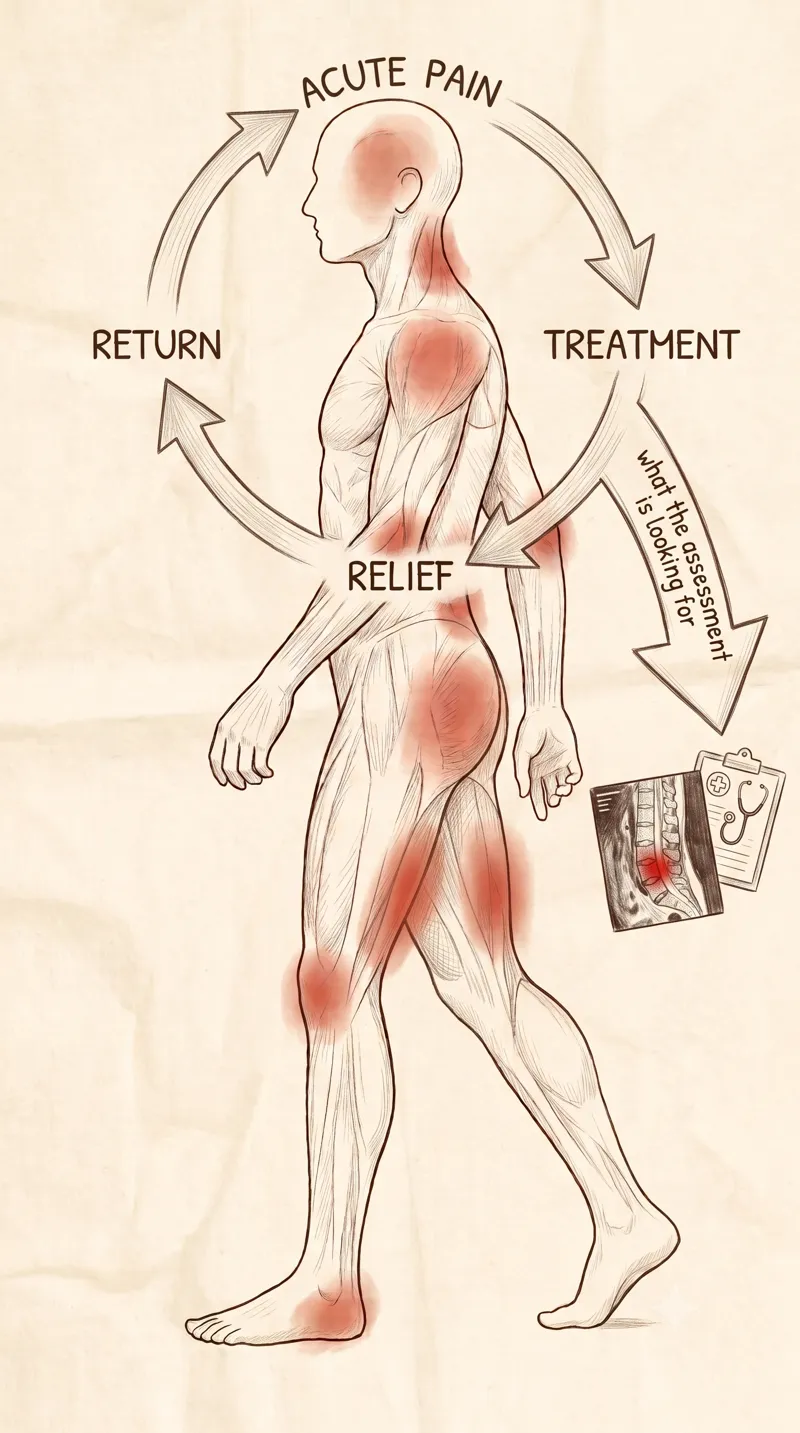
Easing a tight muscle or a painful joint can bring real relief — but if the pattern that overloaded that area is still there, the pain may return. There are many other factors that can affect the outcome even outside the muscular skeletal system. The causes often differ from person to person, and that's what an assessment is for.
You have probably tried a number of things already. Maybe you had some relief — and then, weeks or months later, the same thing in your lower back, neck, shoulder or hip shows up again. That's frustrating but isn't unusual.
In a study following 65,790 adults after a first episode of low back pain, about half recovered and stayed recovered. Just under a third appeared to recover over six months but carried a 37–48% chance of seeking care for it again in every quarter that followed (Norton et al., The Spine Journal, 2016). Recurring pain is one of the most common patterns in musculoskeletal care.
Book Your Assessment · What to expect from a thorough assessment
🚨 When recurring pain isn't just recurring
Pain that comes and goes in a cycle is common. Pain that is steadily getting worse is a different pattern and needs medical review. Go to the emergency department for new loss of bladder or bowel control, numbness around the groin or inner thighs, or new weakness in a limb.
Two people, identical pain — completely different causes
Two people can walk in with the same lower back pain and have entirely different reasons for it. The pain looks the same. The cause is not.
In general, for the muscular skeletal system, the area with pain is not the site for the cause of the problem. This is why treatment that not full addresses the underlaying causes tends to only provide temporary relief.
The treatment can settle the symptom, but it may not reach whichever driver is specific to that person. Without an examination you might not know the true causes.
I've tried physiotherapy, chiropractic or massage — why does it still come back?
Each of those can help, and the answer isn't that you picked the wrong one. What determines whether relief lasts is whether the driver was found, and the driver often sits somewhere other than where the pain is felt. Sciatica is the clearest example. Nerve-related leg pain is frequently produced by patterns in the lower back, pelvis and hips rather than at the spot where it's felt.
Treatment concentrated on one factor may ease the symptom but still leave other factors that’s irritating the nerve untouched — so it returns. See the sciatica page. Sometime imaging might be required.
The question that changes the outcome isn't which type of therapist. It's often whether the whole pattern was detected and addressed.
How a comprehensive assessment may help
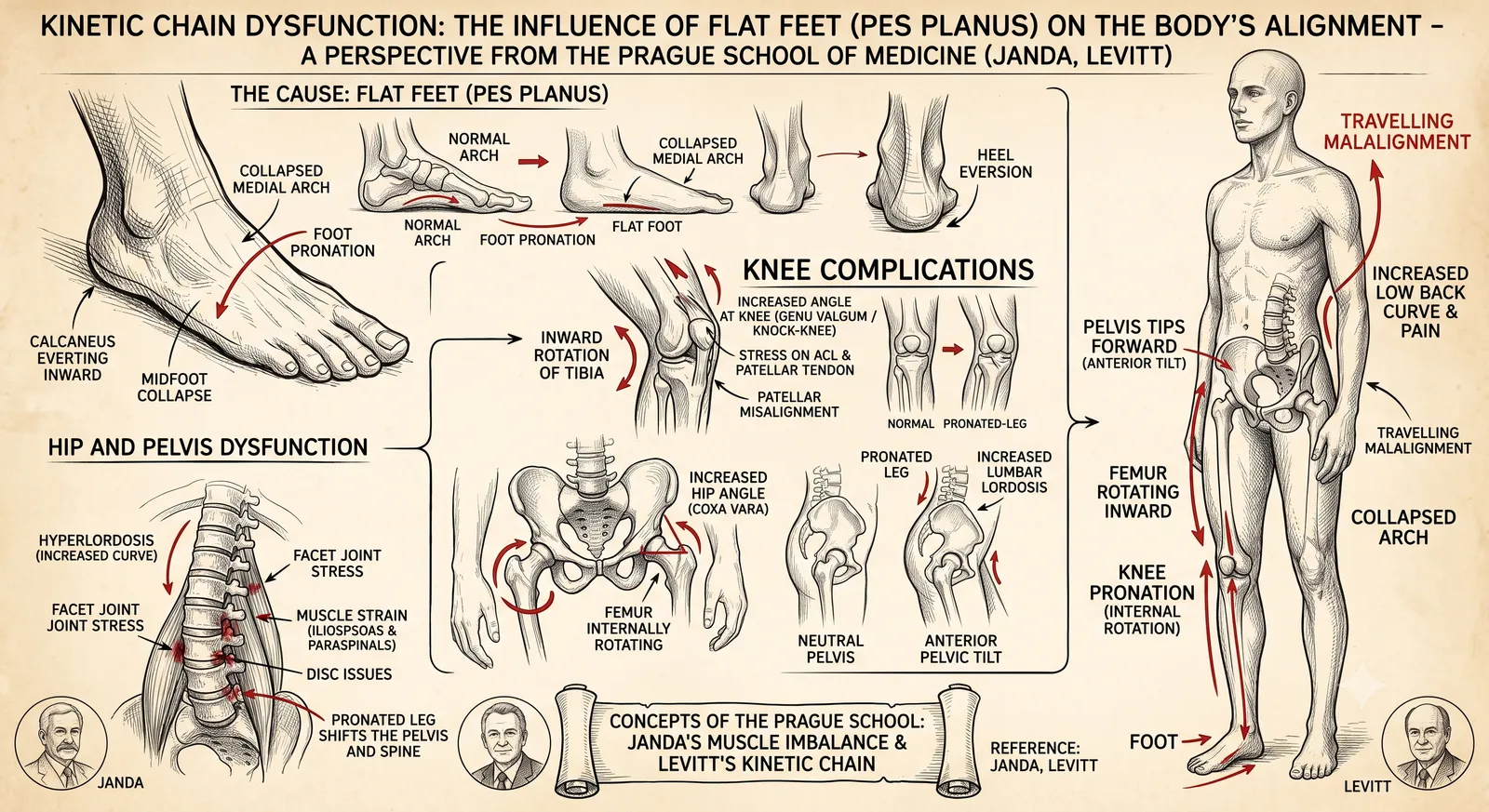
Feet as an example of the complexities that can be involved.
The painful area is examined, and so is everything that affects it. Alleviating the pain is usually the first priority — that part doesn't change.
What changes the recurrence is also finding what produced it, and that commonly sits somewhere other than where you feel it. Depending on your symptoms, the examination may cover breathing and posture, the neck, thoracic spine and ribs, the lumbar spine, pelvis and sacroiliac joints, the hips, gait, and the feet — each finding tested against your symptoms to establish which ones are relevant to you.
Two contributors are worth explaining, because they're commonly missed and they may explain something about your recurrence.
A stabilising pattern the body no longer runs well. In people with recurrent low back pain, the deep stabilising muscle of the trunk activates late, and the way that movement is represented in the brain's motor map has reorganised — the nervous system keeps defaulting to an older, compensatory pattern. This is reversible, and it has been shown directly. Twenty people with recurrent low back pain were assigned either two weeks of specific training for that muscle or two weeks of self-paced walking. In the training group the motor map shifted back toward normal and the muscle's timing improved. In the walking group it didn't (Tsao, Galea & Hodges, Eur J Pain, 2010). The pattern responds to the right practice, not to activity in general.
A nervous system that has become more sensitive. When pain persists, the system that carries it can become more reactive, so less is needed to set it off — a process called central sensitisation (Woolf, Pain, 2011). This doesn't mean the pain is imagined. It's a physical change in how signals are processed, and it explains why pain can outlast the injury that started it.
Neither of these is universal and neither can be assumed. They are found, or ruled out, through the examination. What to expect from a thorough assessment →
What changes the pattern
Once the assessment identifies what's driving the recurrence, treatment can address that rather than chase the symptom. Sometimes this is not possible – sometimes a second opinion may help.
Where a stabilising or movement pattern is the driver, the aim is to retrain it — and as the research above shows, that takes specific practice rather than general activity. The work is on how the trunk supports itself before you move: timing, pressure and breathing rather than strength. How core stability and breathing actually work →
Where restricted joints or overworking muscles are holding the pattern in place, those are treated first, because a pattern can't change while the mechanics prevent it. The retraining uses Dynamic Neuromuscular Stabilisation — positions from infant motor development that make the correct coordination happen without you having to think about it. The exercises look simple, and their value depends entirely on doing them with the right activation, which is why the early ones are done with someone watching. Learn more about DNS →
Ten to fifteen minutes of daily practice is usually what makes a pattern automatic. It does more than session frequency does.
Relief is not the same as change
Manual treatment can create an immediate change: a restricted joint may move more freely, an overactive muscle may relax, and pain may decrease. But an immediate change in symptoms or mobility is not necessarily a change in the underlying movement pattern. A lasting change requires the patient to learn and repeatedly use a more efficient movement strategy. Three things need to come together:
- The mechanical conditions must allow the movement. A restricted joint or segment can prevent a person from performing a movement normally. The restriction may therefore need to be addressed first. Manual therapy can create the necessary freedom of movement, but active movement is what allows the patient to use and retain that change.
- Excessive muscle activity may need to be reduced. A markedly hypertonic or overactive muscle can dominate a movement and maintain pain or restriction. In such cases, techniques such as post-isometric relaxation, soft-tissue treatment or other appropriate methods can first reduce excessive activity. The goal is not simply to make the muscle relax, but to make a more appropriate movement possible.
- The patient has to actively learn the new pattern. This is where exercise becomes essential. The exercise needs to correspond to the problem being treated: mobility work where mobility is restricted, progressive strengthening where capacity is insufficient, and—most importantly—coordinated movement practice where the problem is one of motor control.
Lasting change means restoring the way the body was designed to move. DNS Learn more about DNS → is a method to reactivate the natural movement and stabilization patterns that developed during early childhood. The therapist can remove restrictions and reduce excessive tension, but the patient has to actively practice these patterns. Through repetition, the nervous system can re-activate to use them again as a natural part of movement. There are other training methods available at Scandinavian clinic.
The Scandinavian Clinic
- The examination doesn't stop at the painful area. Breathing, posture, the joints above and below, and the muscles doing too much are all assessed as standard, alongside the region that hurts.
- Swedish-trained orthopaedic manual therapy. Five years of university-level training in Sweden, with a strong emphasis on clinical reasoning and biomechanical assessment.
- Czech-trained in Dynamic Neuromuscular Stabilisation, at the Prague School of Rehabilitation Medicine.
- Covered by most extended health plans. As a Registered Massage Therapist, Eva's treatments are eligible for extended health benefits. For ICBC or WorkSafeBC, call (604) 926-4883 before booking.
Frequently Asked Questions
Should I see a chiropractor, physiotherapist or massage therapist for pain that keeps coming back?
Any of them can help — they're different tools and the right one depends on your situation. What matters more than the profession is whether the driver gets assessed rather than only the painful area. Recurring pain in particular tends to need a look at how you move and stabilise as a whole.
Does"the nervous system has become more sensitive" mean it's in my head?
No. Central sensitisation is a physical change in how the nervous system processes signals (Woolf, 2011). The pain is real. It explains why pain can persist after an injury has healed, and why retraining and desensitising the system can matter alongside treating tissue.
How long until it stops coming back?
It depends on what the assessment finds and how long the pattern has been there. Some things may settle quickly. You'll get a realistic picture after the examination.
Is this covered by insurance?
Eva is a Registered Massage Therapist, so sessions are covered as RMT by most BC extended health plans, and you'll receive an official RMT receipt. For ICBC, WorkSafeBC or similar, call (604) 926-4883 before booking.
Schedule Your Visit
Book an assessment and start treatment based on what the examination finds.Book Your AssessmentSuite 202-101 West 16th Street, North Vancouver · (604) 926-4883
References
- Norton G, McDonough CM, Cabral HJ, et al. Classification of patients with incident non-specific low back pain: implications for research. The Spine Journal. 2016;16(5):567–576.
- Tsao H, Galea MP, Hodges PW. Driving plasticity in the motor cortex in recurrent low back pain. European Journal of Pain. 2010;14(8):832–839.
- Woolf CJ. Central sensitization: implications for the diagnosis and treatment of pain. Pain. 2011;152(3 Suppl):S2–S15.
Written by Eva Andersson, RMT · Last updated August 2026