What a Thorough Assessment Involves
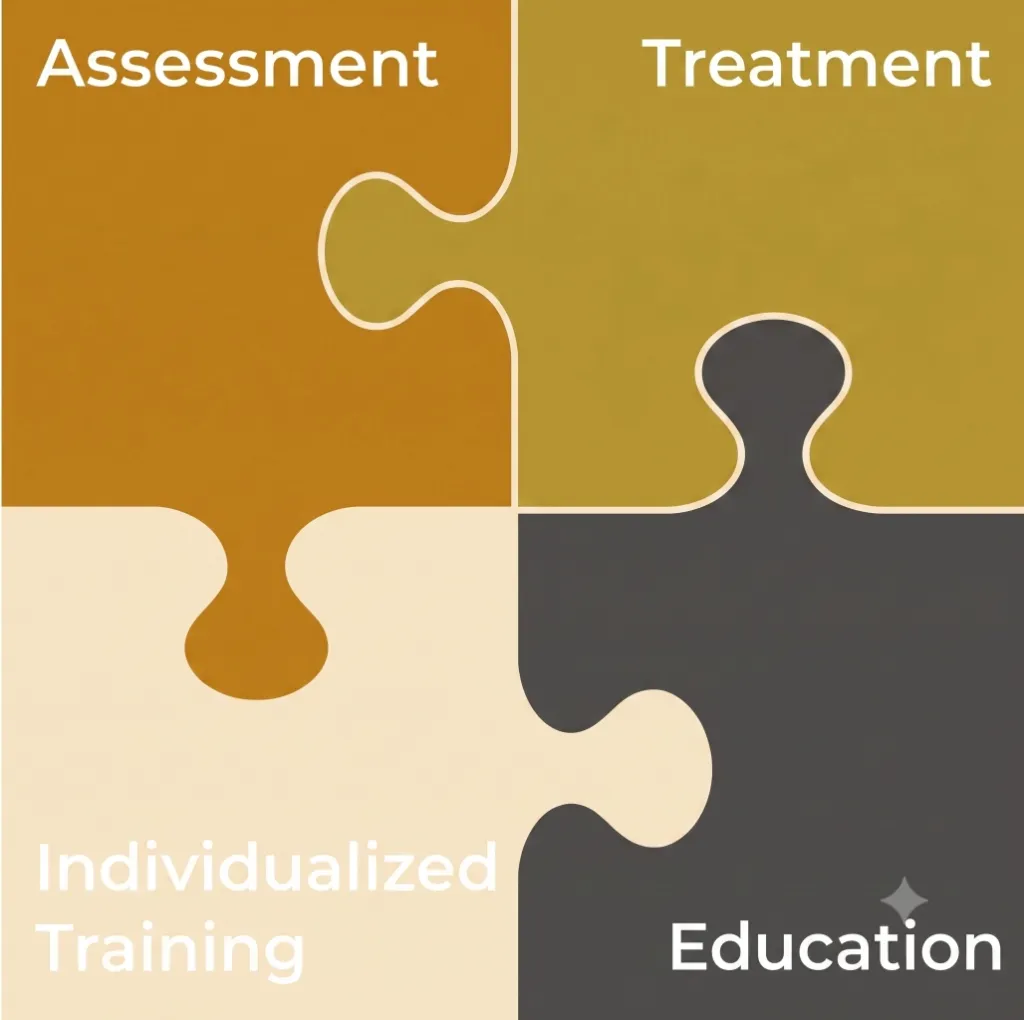
What does a thorough assessment actually include?
Four parts: a detailed history; how you move, tested for lost range and side-to-side differences; individual joints and spinal segments, tested one at a time; and the muscles, tested against each other — what is tight and overworking, what is underactive. The findings are then read together, to establish what is producing your symptoms, how, and what the underlying causes are. Treatment follows from that, and the picture is revised as you respond to it.
Book Your Assessment · Why pain keeps coming back →
What happens on your first visit?
Ideally, book 60 minutes for an initial visit, so there's time for the full assessment and treatment. 45 minutes is also workable. Arrive 10 minutes early to complete the intake form.
Bring a tank top and shorts. The examination depends on being able to see your spine, posture and joint movement directly. If you have previous imaging or diagnostic reports, bring them — not required, but useful context.
The visit begins with a conversation, moves to the physical examination, and usually ends with treatment based on what was found.
How the Process Works
There is no fixed protocol. What is done follows from what the examination finds, and how much of it applies varies — some problems need very little, while complex problems need more.
Assessment. Comprehensive biomechanical assessment.
Restricted mobility. Mobilisation for joints that have lost their normal movement, and where restricted joint play in segmental mobility is present.
Tight muscles. Massage, various soft tissue treatment including fascia, PNF stretching, trigger point treatment, and post-isometric relaxation.
Corrective exercise. To restore proper muscle patterns and movement.
Education. What was found, why it is producing your symptoms, and what to do about it.
The clinical history
The history helps with two main jobs. It narrows the likely mechanical sources before the physical examination begins, and it establishes what you actually need — treatment for a trail runner with recurring hip pain is planned differently from treatment for someone who can't sit through a workday.
The physical examination
What the examination is looking for
For most musculoskeletal pain there is no single damaged structure to find (Hartvigsen et al., The Lancet, 2018). What can be identified is a mechanical pattern — which regions have stopped contributing, which are doing more work than they should, and which movements reproduce the symptom. That pattern is established by testing how you actually move.
The body moves symmetrically and efficiently when it can, and it works as one connected system. When one side moves less than the other, when a segment is restricted, or when a muscle group is doing work its counterpart should share, the body compensates.
Those compensations — asymmetries and departures from efficient movement — are what the examination looks for, because they indicate where the problem is being produced rather than only where it's felt.
How is movement tested?
Shown as an example - initial range of movement testing for a shoulder problem.
Investigation of movement pattern.
Movement testing looks at restrictions in the normal range of motion.
A movement that reproduces your familiar pain or responds in specific muscle testing often shows which structures are involved.
Movement testing usually comes first, to establish where to look more closely in the joint and muscle testing that often follows.
How are joints tested?
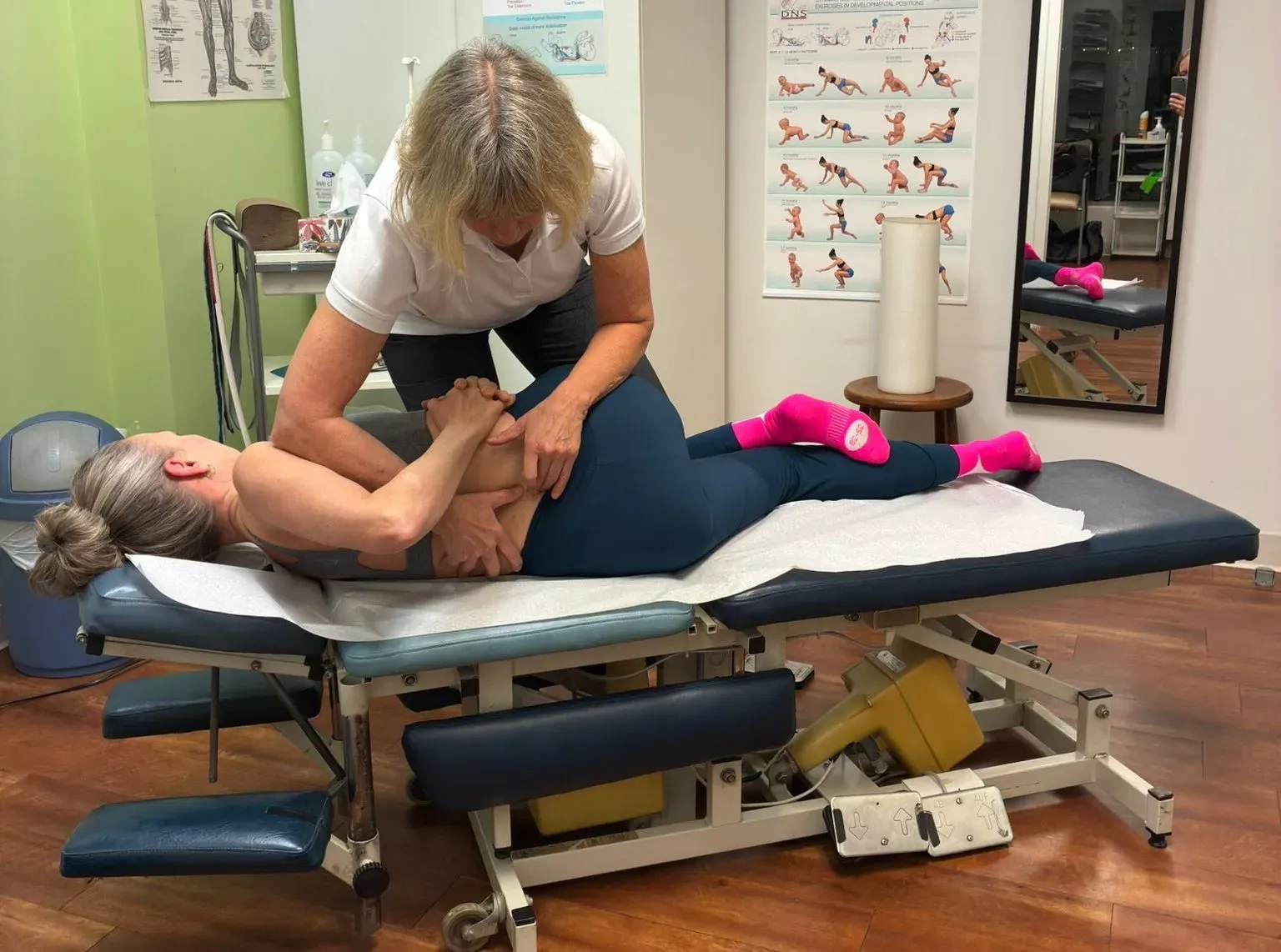
The spine is not one joint but a chain of segments, each contributing its own share of movement. The segments are tested individually.
If there are restrictions in joint play it is usually treatable. Local restrictions often link into chain reactions through the movement system, which is one reason a restricted segment can produce symptoms a long way from itself.
How are muscles tested?
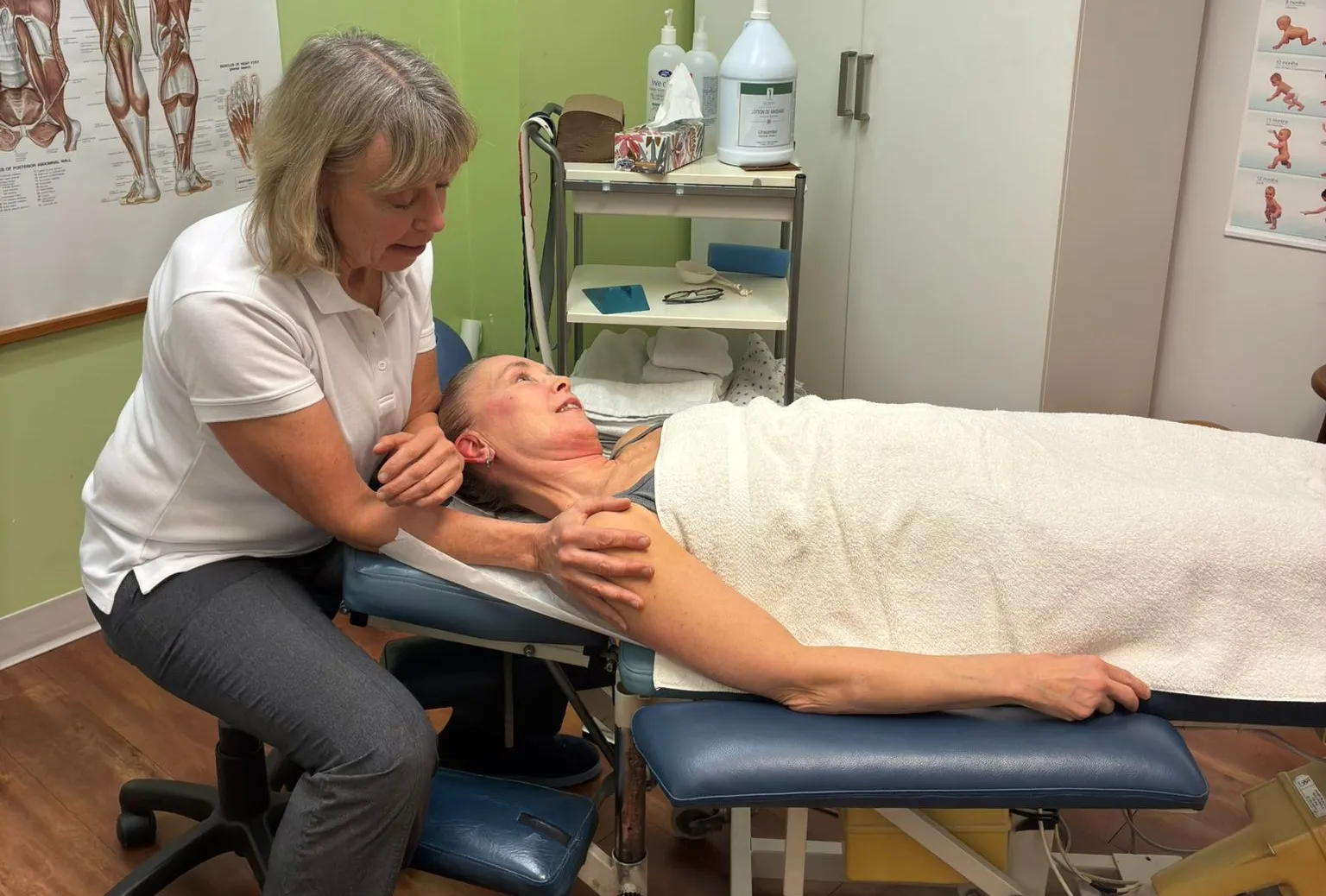
Stretching of shortened neck muscles.
Muscle elasticity and strength are tested. No muscle works in isolation — patterns of movement need to be assessed.
Muscle imbalances — overloaded or underloaded muscles — are common clinical findings.
How treatment begins
Treatment follows the findings, and usually begins in the same visit.
What the examination found is explained in plain language first. Techniques are then chosen to match: soft-tissue work including fascia, joint mobilisation for restricted mobility, specific stretching, and post-isometric relaxation.
A tight muscle can be painful — and because of the pain we tighten up even more, so the cycle may continue until something interrupts it. Early treatment can be beneficial to interrupt the loop. Patterns built up over years are often changed step by step, each session building on the last.
Mild soreness for a day or two afterwards is common.
Should you rest?
Usually not for long. For most musculoskeletal problems we recommend movement sooner rather than later. Movement maintains blood flow to the area, keeps it from stiffening, and gives healing tissue the mechanical input it needs. For back pain specifically, guidelines recommend staying active and returning to normal activity (Foster et al., The Lancet, 2018).
We will discuss how much and which movements. Part of the first visit is working out what to keep doing, what to modify for now, and what to leave until it settles. You'll be given a realistic plan based on what was found and what you need.
The Role of Exercise
Progression in treatments and lasting results often depend on what happens between sessions.
There is seldom a standard programme — what you're given follows from the examination and your specific issues. As symptoms settle the exercises often become more central in your recovery. Where a desk, car seat or sleeping position is contributing, ergonomic advice may be part of the plan.
For some people this may include Dynamic Neuromuscular Stabilisation — training the deep stabilising system of the trunk. How core stability and breathing work →
What will you understand about your own condition?
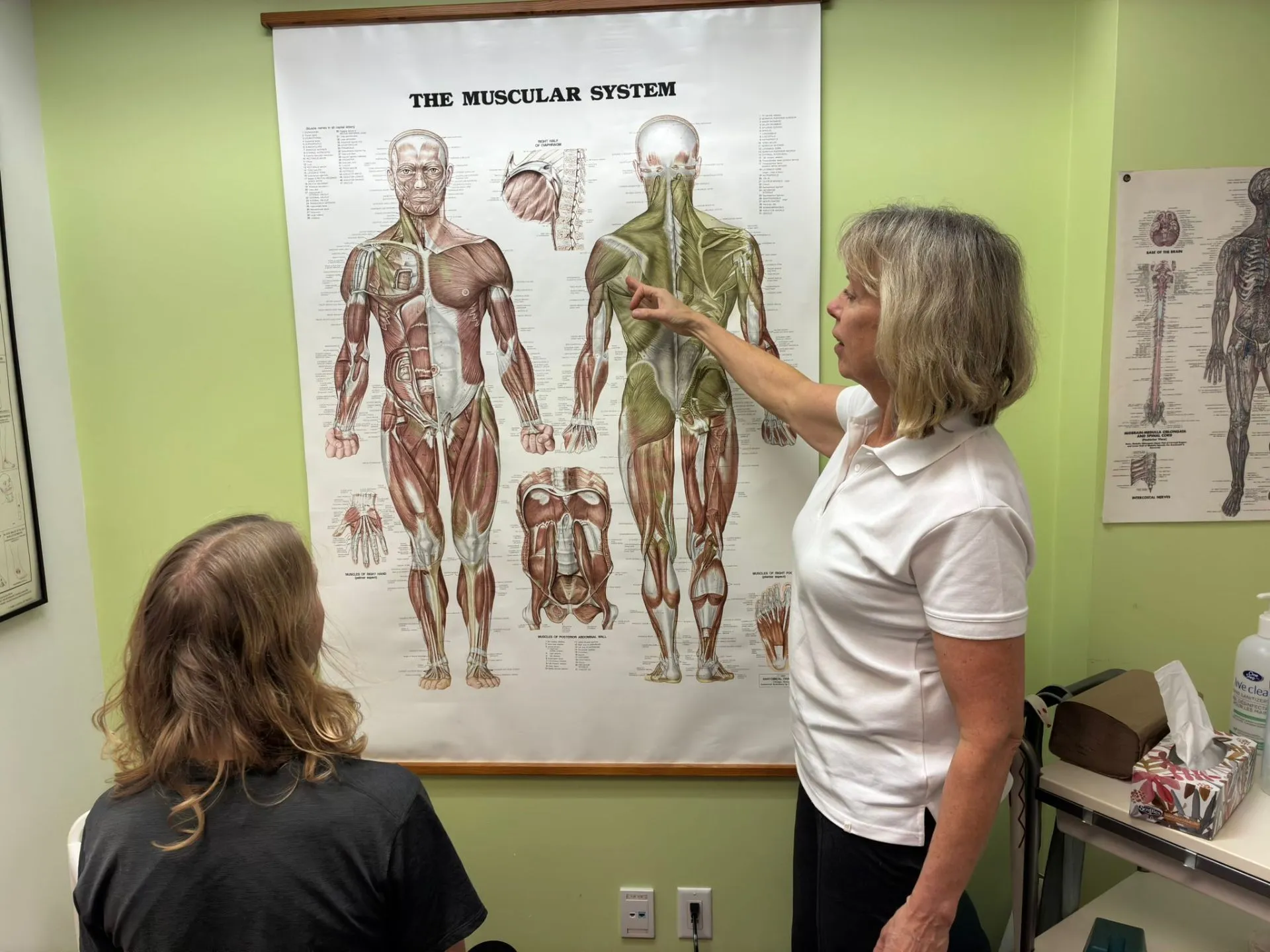
You're involved in the work from the first visit. Findings are explained as they're made — what was found, why it matters for your symptoms, what will be done about it, and what you can do yourself.
Treatment that depends on what you do between sessions only works if you understand why you're doing it.
What happens after the first visit?
A second visit usually begins by checking what changed — which findings have settled, which haven't, and how the home exercises felt. Treatment is adjusted from there. Where something hasn't responded the way the examination predicted, it's re-examined rather than simply repeated.
How far apart visits are spaced depends on the problem. Acute problems are often seen closer together, long-standing ones further apart.
Is the assessment covered by insurance?
Extended health: most BC plans cover Registered Massage Therapy. You'll receive an official RMT receipt to submit for reimbursement.
ICBC, WorkSafeBC, RCMP, MSP-exempt programs: do not book online — call (604) 926-4883 so the correct intake procedure is followed.
Cancellations: 24 hours' notice is required; late changes are subject to the full session fee.
The Scandinavian Clinic
- Every treatment begins with the assessment described on this page.
- Swedish-trained orthopaedic manual therapy. Five years of university-level training in Sweden, with a strong emphasis on clinical reasoning and biomechanical assessment.
- Czech-trained in Dynamic Neuromuscular Stabilisation, at the Prague School of Rehabilitation Medicine.
- Covered by most extended health plans. As a Registered Massage Therapist, Eva's treatments are eligible for extended health benefits.
Eva Andersson has practised in North Vancouver since 1994. She lives on the North Shore, and spends her own time hiking, biking, paddling and skiing. More about Eva →
Frequently Asked Questions
Do I need a doctor's referral?
No. You can book directly with a Registered Massage Therapist in BC. If your visit falls under ICBC, WorkSafeBC or a similar programme, call the clinic first so intake is handled correctly.
Why do I need to change into shorts and a tank top?
It is beneficial, not required. The examination depends on seeing your spine, posture and joint movement directly. Loose or heavy clothing hides exactly the asymmetries the assessment is designed to find.
Will I be treated on the first visit?
A 60-minute visit (or 45 minutes) has time for the history, the examination and initial treatment based on the findings.
Do I need a scan first?
Usually not. In people with no symptoms at all, disc degeneration is present in 37% of 20-year-olds and 96% of 80-year-olds, and disc bulges in 30% and 84% (Brinjikji et al., 2015) — so a scan often reports changes that aren't causing your symptoms, and guidelines advise against routine early imaging for ordinary back pain (Foster et al., 2018). Where red flags are present or recovery stalls, imaging becomes useful and you'll be advised to see your family physician.
How many sessions will I need?
It depends on the findings. Some acute problems settle within a few treatments; patterns built over years are changed gradually. You'll get a realistic estimate after the examination.
Is this massage therapy or something else?
It is Registered Massage Therapy. Assessment, manual treatment, joint mobilisation and rehabilitation exercise all fall within RMT scope in BC, and treatments are covered as RMT by most extended health plans.
Should I rest, or keep moving?
For most problems, a day or two of relative rest and then gradual return to movement. Continued rest tends to prolong things. What changes is usually which movements and how much, and that's set out for you after the examination (Foster et al., 2018).
What will my exercise programme look like?
It depends on what the examination found — there's no standard set. What is consistent is that you're taught each movement properly before you take it away, and that the programme changes as you improve rather than staying the same.
Will you look at my workstation?
Where sitting or a work position is contributing to the problem, ergonomic assessment and advice are part of the plan. Whether it's relevant depends on the condition. Photographs of your desk or workspace are useful if it is.
Will I need to come back once it's better?
Not as a standing arrangement. You will be given preventative exercises. For some conditions it may be beneficial to do a follow-up in 6–12 months.
Schedule Your Visit
Suite 202-101 West 16th Street, North Vancouver · (604) 926-4883
References
- Hartvigsen J, Hancock MJ, Kongsted A, et al. What low back pain is and why we need to pay attention. The Lancet. 2018;391(10137):2356–2367.
- Brinjikji W, Luetmer PH, Comstock B, et al. Systematic literature review of imaging features of spinal degeneration in asymptomatic populations. AJNR Am J Neuroradiol. 2015;36(4):811–816.
- Foster NE, Anema JR, Cherkin D, et al. Prevention and treatment of low back pain: evidence, challenges, and promising directions. The Lancet. 2018;391(10137):2368–2383.
Written by Eva Andersson, RMT · Last updated August 2026