Back Pain Treatment in North Vancouver
For most back pain, no single damaged structure can be identified — including on a scan. What can usually be found is a movement problem: the lower back taking on work that the hips, mid-back, or breathing mechanics should be sharing. It is the area that ends up overloaded, and it is often not where the problem starts. That is what an assessment is for.
Back pain changes the way you move through your day. Bending to tie your shoes becomes a negotiation. Sitting through a meeting turns into a countdown. A weekend hike on the North Shore trails — something you used to do without thinking — now needs recovery time you didn't plan for.
If it has lasted more than a few weeks, or keeps coming back despite stretching and rest, the problem is usually not tight muscles.
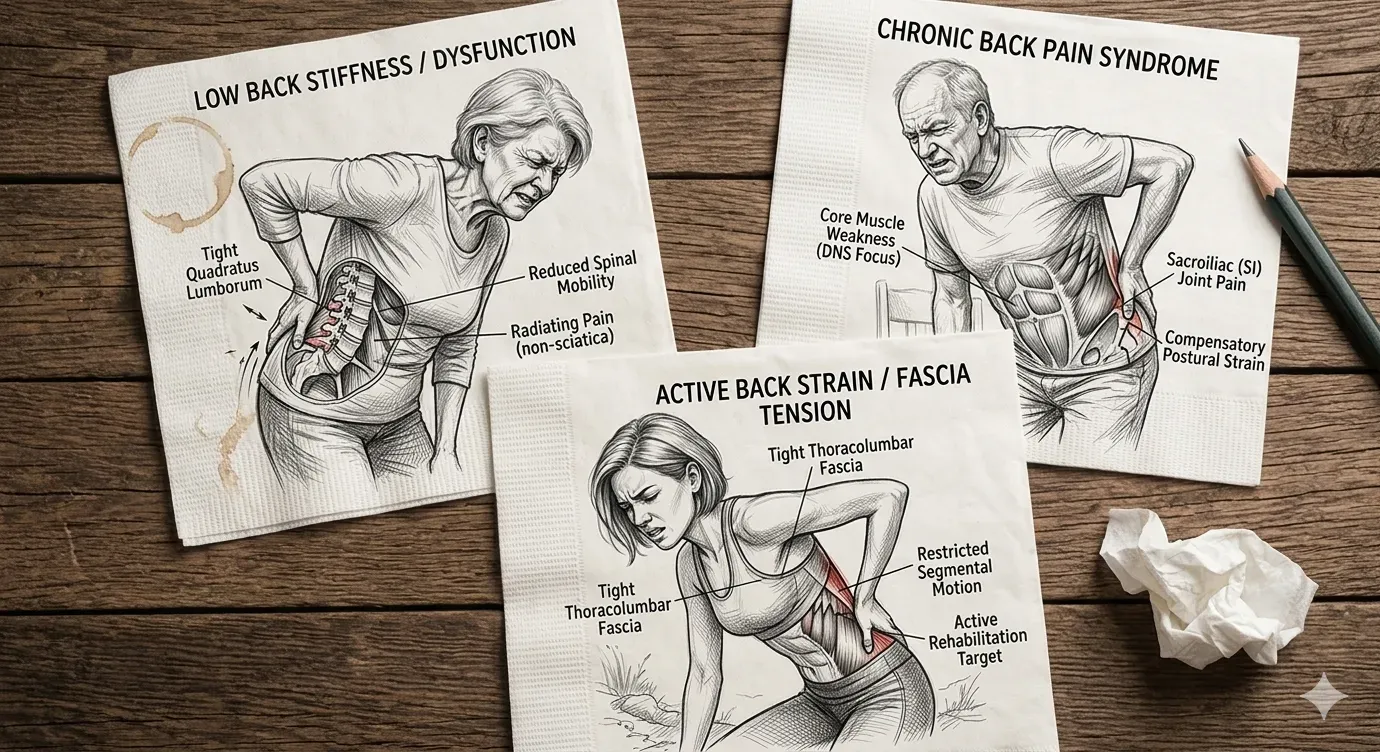
Common symptoms:
- Stiffness or aching in the lower back, especially in the morning or after sitting
- Sharp pain when bending, lifting, or twisting
- Pain spreading into the buttock or upper leg
- Difficulty standing upright after sitting for a long period
- A feeling that the back"gives out" or lacks support during activity
Back pain that radiates down the leg may involve the nerve — see our sciatica page for nerve-related leg pain.
When should back pain be seen?
Most back pain settles and is not a sign of anything dangerous. A few situations need prompt attention.
🚨 Emergency Red Flags
Go to the emergency department immediately if back pain comes with new loss of bladder or bowel control, numbness around the groin or inner thighs, or new weakness in both legs. These are rare but can signal cauda equina syndrome, which is a genuine emergency. Also seek prompt medical review for back pain after a significant injury, or with fever or unexplained weight loss.
It is worth an assessment rather than waiting it out if your back pain lasts beyond two to three weeks, disrupts your sleep, or has started reducing how much you move. In general, the sooner treatment begins, the more likely symptoms are to improve.
Why your lower back is the place that hurts
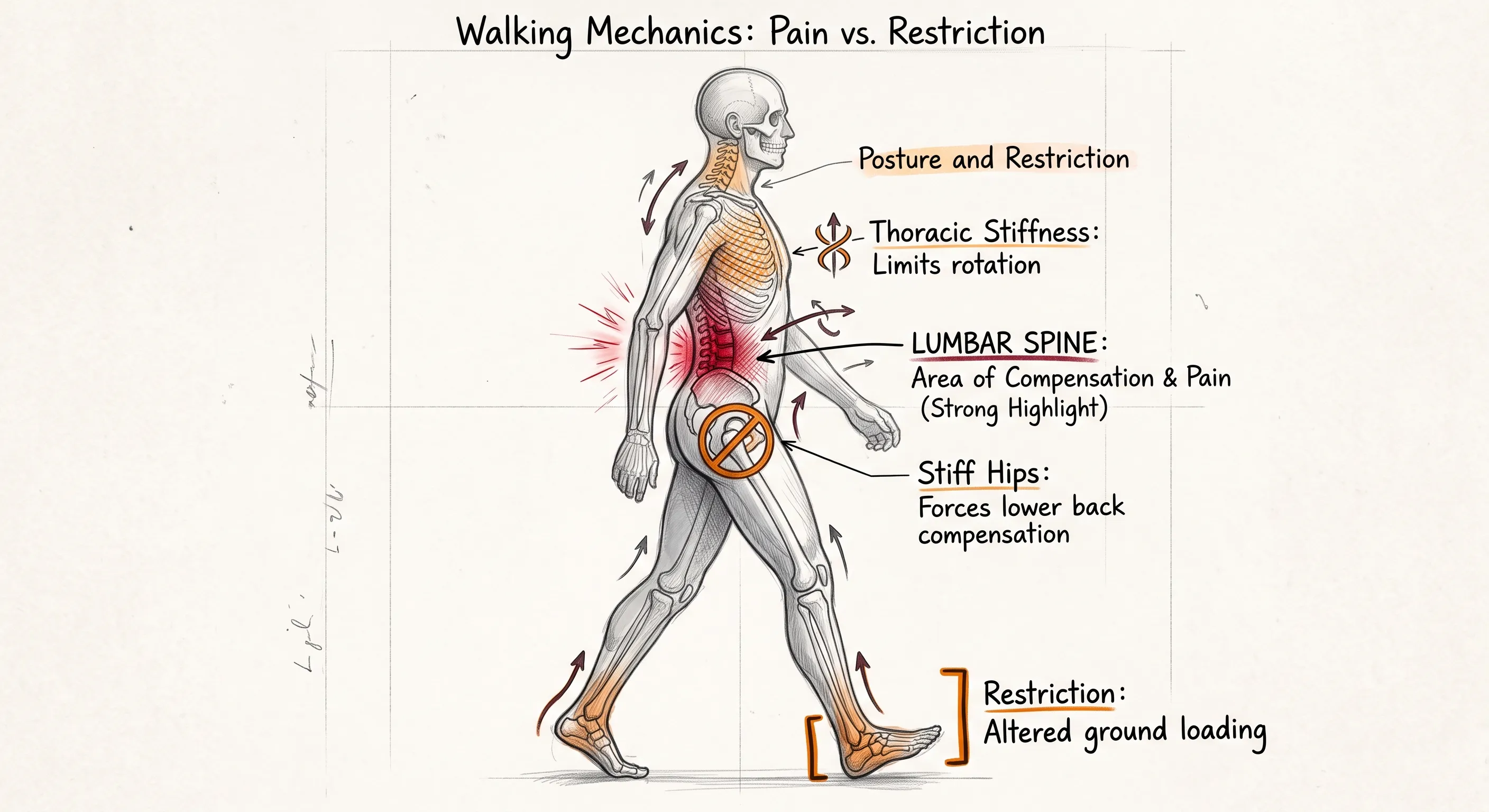
The lumbar spine is frequently the region compensating for a restriction somewhere else.
One school of thought asks a different question about back pain: not which structure is damaged, but which movement or control problem is producing the load.
On that view, the lumbar spine is frequently the region compensating for a restriction somewhere else. The regions examined include:
- The hips: Stiff hips mean the lower back moves further, more often, to make up the range.
- The thoracic spine and ribs: When the mid-back doesn't rotate, the lumbar spine twists instead — a joint built for very little rotation doing work it isn't shaped for.
- The diaphragm and breathing: Covered in its own section below.
- The abdominal wall and pelvic floor: Without coordinated control here, spinal loading rises.
- The feet and ankles: Restriction here changes how load arrives from the ground up.
- The neck: Included because the whole system is examined, and posture matters.
For nearly everyone with back pain, no single specific structural cause can be identified on examination or imaging (Hartvigsen et al., The Lancet, 2018). What the movement examination can find is which of the above is contributing in your case.
Dysfunction in the movement system
One school of thought puts the emphasis on how a joint behaves while it moves, rather than on what it looks like at rest. When a joint tracks well through a movement, the load spreads across the whole joint surface and the muscles around it don't have to compensate. When movement patterns are poor, the same joint takes load unevenly, the muscles work harder to control it, and the tissues carry more than they were designed to handle — repeated a few thousand times a day.
Which muscles are doing too much:
Painful muscles are usually overworking rather than weak. In back pain, the ones commonly found tight are the hip flexors, the lumbar erectors, quadratus lumborum, and piriformis; the ones commonly found underworking are the gluteal muscles and the lower abdominal wall.
Trigger points:
Tender points in these muscles frequently reproduce the back pain a patient describes. Settling them often reduces symptoms directly and makes movement work possible.
Breathing and the stability of your spine
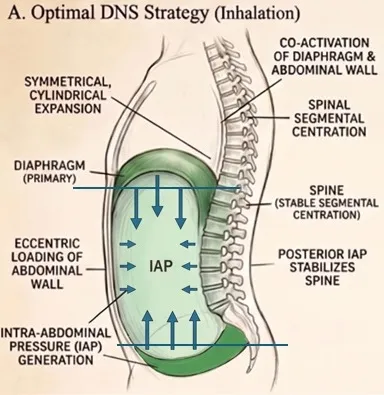
The diaphragm is a breathing muscle, and it is also a postural one. Working alongside the abdominal wall, back muscles, and pelvic floor, the diaphragm generates pressure inside the abdomen (intra-abdominal pressure) that stabilizes the lumbar spine from the inside — before an arm or a leg moves. Raising that pressure produces a measurable difference in spinal stability independent of the big back muscles (Hodges et al., J Appl Physiol, 2000).
In people with chronic low back pain, this doesn't work as well. In one study, dynamic MRI taken during arm and leg loading showed smaller diaphragm movement and a higher resting position in people with chronic low back pain than in people without it (Kolář et al., JOSPT, 2012).
What that looks like in practice: Breathing into the upper chest rather than the lower ribs and abdomen, an inability to generate pressure low down, and the back muscles bracing to make up the difference.
What about the scan?
Degenerative changes in the spine are common, and they are common in people with no pain at all.
In a systematic review of imaging in people without symptoms, disc degeneration was present in 37% of 20-year-olds and 96% of 80-year-olds. Disc bulges: 30% at twenty, 84% at eighty. Facet joint degeneration: 4% at twenty, 83% at eighty (Brinjikji et al., AJNR, 2015).
Findings like these are largely a feature of getting older. They appear on a report as though they explain the pain, but they usually explain very little on their own — which is why guidelines advise against routine early imaging for ordinary back pain (Foster et al., The Lancet, 2018). Where red flags are present or recovery stalls, imaging becomes useful, and you'll be advised to see your family physician for medical evaluation.
Treatment for back pain at Scandinavian Clinic
Find where the load is coming from, restore movement, settle tone, restore the stabilising system, then retrain movement itself. Two people with identical scans can need entirely different treatment, and the movement examination is what decides.
- Examine the whole system: Breathing and posture first, then the neck, thoracic spine and ribs, lumbar spine, pelvis and sacroiliac joints, hips, and feet — tested against your symptoms to establish which findings are relevant to your pain.
- Restore joint function: Gentle, low-velocity mobilisation to restricted segments and joints — spinal, rib, pelvic, and hip — restoring normal joint play.
- Reduce muscle tightness: Massage and soft-tissue work including fascia, post-isometric relaxation, specific stretching, and trigger point treatment.
- Restore breathing and abdominal pressure: Retraining the diaphragm to work with the abdominal wall and pelvic floor, so the spine is stabilised from the inside rather than braced from the outside.
- Retrain the stabilising pattern in developmental positions: Dynamic Neuromuscular Stabilization uses positions from infant motor development — supine, side-lying, four-point kneeling, half-kneeling — not as an exercise fashion, but because these positions make correct coordination happen without you having to think about it. [Learn more about DNS →]
- Train movement, not isolated muscles: Hip hinging, squatting, rolling, reaching, lifting, and walking. The nervous system learns coordinated movement; it doesn't learn much from repetitions of a single muscle in isolation. Your home exercises emphasise quality of movement over quantity of repetitions.
Staying active alongside all of this matters: guidelines consistently favour keeping moving and returning to normal activity over rest, which tends to prolong the problem (Foster et al., 2018).
What to expect
Assessment and treatment begin in the same session. You'll be told what the examination found, which findings relate to your symptoms, and what the plan is.
Early sessions focus on settling pain and restoring movement. As that improves, sessions shift toward stabilising and movement work, and toward managing it yourself.
Uncomplicated back pain often improves over a handful of sessions. Long-standing or recurring back pain takes longer, and you'll get a realistic timeline based on what the assessment finds rather than a standard package.
The home practice carries a good share of the work. It's a small number of movements done well, not a long list.
The Scandinavian Clinic
- Comprehensive assessment: Finding where the load originates across the whole movement system.
- Swedish-trained orthopaedic manual therapy. Five years of university-level training in Sweden, with a strong emphasis on clinical reasoning and biomechanical assessment.
- Czech-trained in Dynamic Neuromuscular Stabilization: Trained in the Prague School tradition. [Learn more]
- Covered by most extended health plans: As a Registered Massage Therapist, Eva's treatments are eligible for extended health benefits.
Frequently asked questions
Is my back pain serious?
Most back pain is not dangerous, even when it's very painful. The signs that need urgent care are new bladder or bowel changes, numbness around the groin or inner thighs, or new weakness in both legs. Back pain after a major injury, or with fever or unexplained weight loss, needs prompt medical review.
Do I need an MRI or X-ray?
Usually not, early on. Degenerative findings are present in most people without pain — disc degeneration in 37% of asymptomatic 20-year-olds and 96% of asymptomatic 80-year-olds (Brinjikji et al., 2015) — so a scan often reports changes that aren't causing the symptoms. Guidelines advise against routine early imaging for ordinary back pain (Foster et al., 2018).
My scan showed disc degeneration. Isn't that the cause?
Not necessarily. Those changes are largely part of getting older and are found in the great majority of people over fifty who have no back pain at all. What the assessment looks for is what's actually loading the area now.
Should I rest or stay active?
Stay as active as your pain allows. Guidelines favour movement and a return to normal activity over rest (Foster et al., 2018).
Why would you look at my breathing for back pain?
Because the diaphragm helps stabilise the lumbar spine, not just move air. People with chronic low back pain show measurably smaller diaphragm movement during arm and leg loading than people without it (Kolář et al., 2012).
Is massage enough on its own?
Massage relieves pain and tension and is a key part of the treatment. For back pain that lasts or recurs, it works alongside restoring movement and retraining how the area is loaded.
Schedule your visit
Book an assessment and start treatment based on what the examination finds.
Book Your AssessmentSuite 202-101 West 16th Street, North Vancouver · (604) 926-4883
References
- Hartvigsen J, Hancock MJ, Kongsted A, et al. What low back pain is and why we need to pay attention. The Lancet. 2018;391(10137):2356–2367.
- Foster NE, Anema JR, Cherkin D, et al. Prevention and treatment of low back pain: evidence, challenges, and promising directions. The Lancet. 2018;391(10137):2368–2383.
- Brinjikji W, Luetmer PH, Comstock B, et al. Systematic literature review of imaging features of spinal degeneration in asymptomatic populations. AJNR Am J Neuroradiol. 2015;36(4):811–816.
- Kolář P, Šulc J, Kynčl M, et al. Postural function of the diaphragm in persons with and without chronic low back pain. JOSPT. 2012;42(4):352–362.
- Hodges PW, Butler JE, Gandevia SC, et al. Changes in intra-abdominal pressure during postural and respiratory activation of the human diaphragm. J Appl Physiol. 2000;89(3):967–976.
Written by Eva Andersson, RMT · Last updated July 2026