Neck Pain & Whiplash Treatment in North Vancouver
What causes neck pain, and is whiplash different?
Most neck pain comes from posture, muscle tension, and everyday load on the neck's joints, and the majority improves within a few weeks. Whiplash — from a sudden jolt of the head, usually in a car accident — is a distinct injury with its own recovery pattern. Neck pain can also be the source of headaches. Because each of these needs a slightly different approach, a thorough assessment comes first.
Neck pain rarely stays in one place. It creeps into your shoulders, wraps around the base of your skull, and may show up as tension headaches you blame on stress or screen time. Turning your head to check a blind spot becomes stiff and guarded. Sleep gets disrupted because no pillow position feels right.
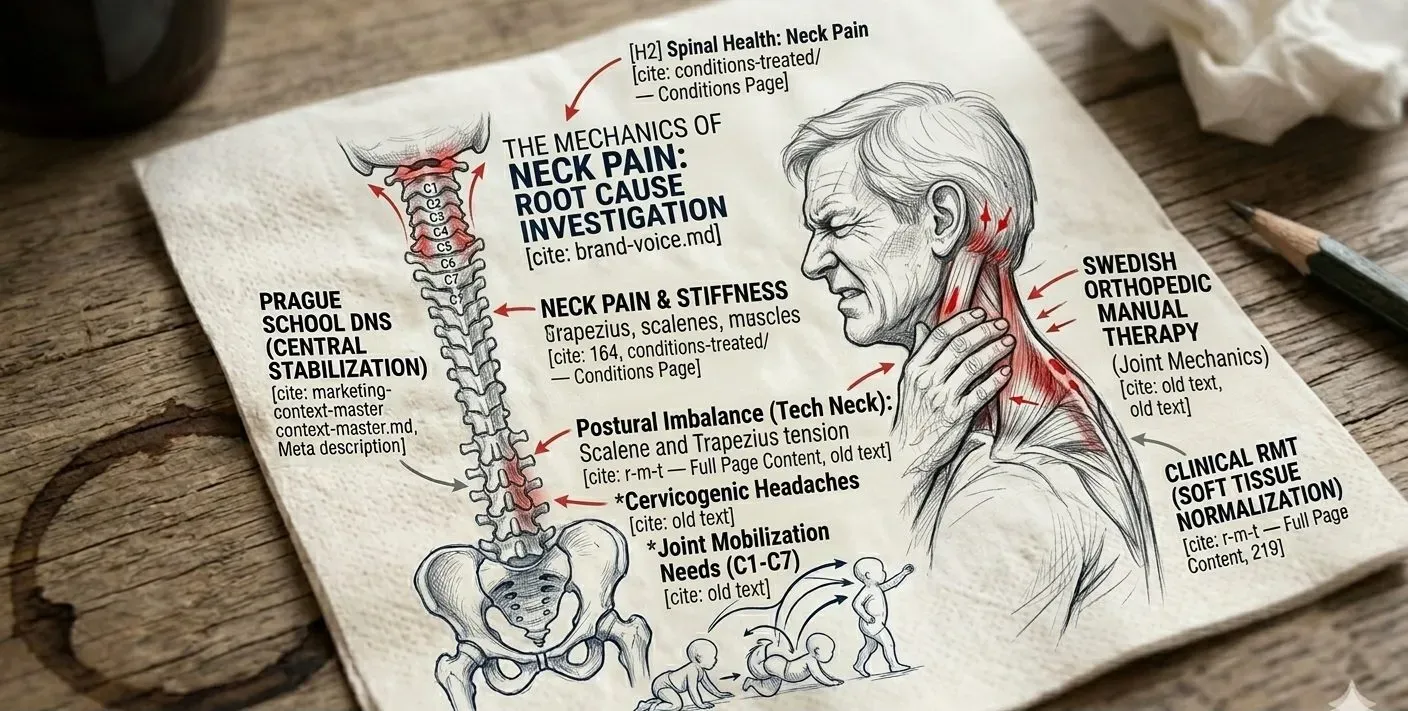
Most people assume neck pain is caused by posture or stress. Often that's part of it — but persistent neck pain will usually involve muscle tightness and imbalances, joint restrictions. At Scandinavian Clinic, Eva Andersson, RMT, uses Registered Massage Therapy to assess your neck pain properly and address the movement mechanics and muscle imbalances contributing to your pain.
Understanding Neck Pain
Where neck pain comes from?
- Muscle strain: This is the most common cause. It can happen from poor posture, working at a computer for long periods, sleeping in an awkward position, or overuse of the neck muscles.
- Joint problems: The small joints between the neck bones can become restricted in mobility, develop arthritis with age, leading to pain and stiffness.
- Disc problems: The discs between the neck vertebrae can bulge or herniate, putting pressure on nearby nerves.
- Nerve compression: A pinch nerve can result from a herniated disc or bone spurs.
- Injuries: Sudden movement, such as in car accident (whiplash), sports injuries, or falls, can damage muscles, ligaments, or other structures in the neck.
- Stress and tension
Common symptoms we treat:
- Stiffness or pain when turning your head, especially to one side
- Aching at the base of the skull or behind the eyes
- Pain or tension radiating into the shoulder or between the shoulder blades
- Difficulty finding a comfortable sleeping position
- Headaches that start at the back of the head and move forward
- Numbness, tingling, or a"heavy" feeling in one or both arms
Neck pain tends to build gradually — from occasional stiffness to constant tightness, reduced range of motion, and secondary headaches. Earlier treatment usually means faster recovery.
When to seek treatment: if neck stiffness or pain has lasted more than two weeks, if you've lost range of motion, or if you're getting headaches or arm symptoms alongside neck pain, a clinical assessment will clarify what's happening. (For urgent warning signs, see the red-flag section below.)
Can neck pain cause headaches?
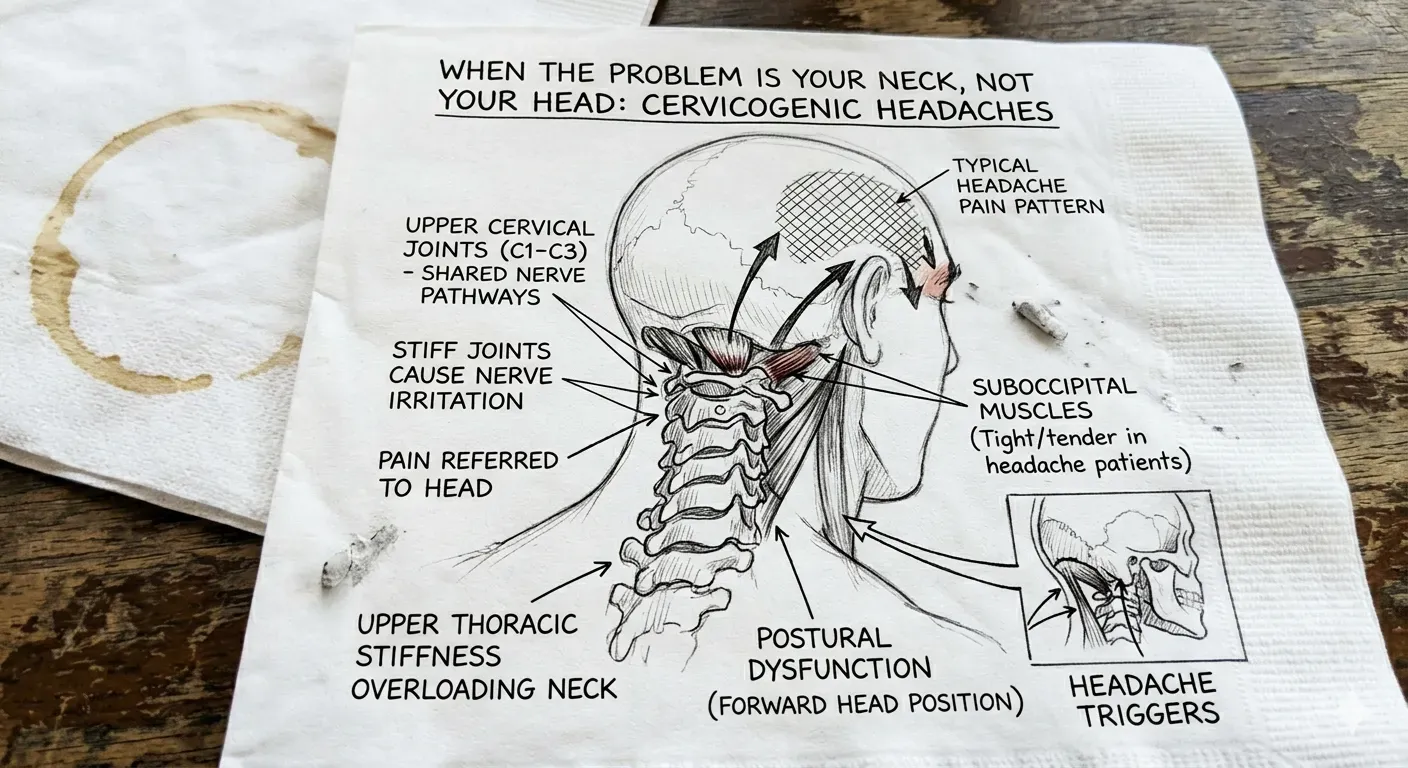
Yes — and it's one of the least-explained parts of neck pain. Problems in the neck, e.g. muscle-tightness and joint restriction can produce headaches that often starts at the base of the skull and spread forward — a pattern called cervicogenic headache.
This is distinct from migraine, though the two often overlap. Neck pain is a more common feature of migraine than nausea (Calhoun et al., Headache, 2010) — so having neck pain with headaches doesn't automatically mean the neck is the source. The distinction matters: cervicogenic headache comes from problems in the neck and tends to respond to exercise and manual therapy, and there is moderate-quality evidence that specific neck and shoulder-girdle exercise help cervicogenic headache over the longer term (Kay, Gross et al., Cochrane Review, 2012). Migraine-associated neck pain is often part of the migraine process itself. Because they need different approaches, an assessment — rather than a guess from symptoms — is the reliable way to tell them apart.
What is whiplash, and how is it different from ordinary neck pain?
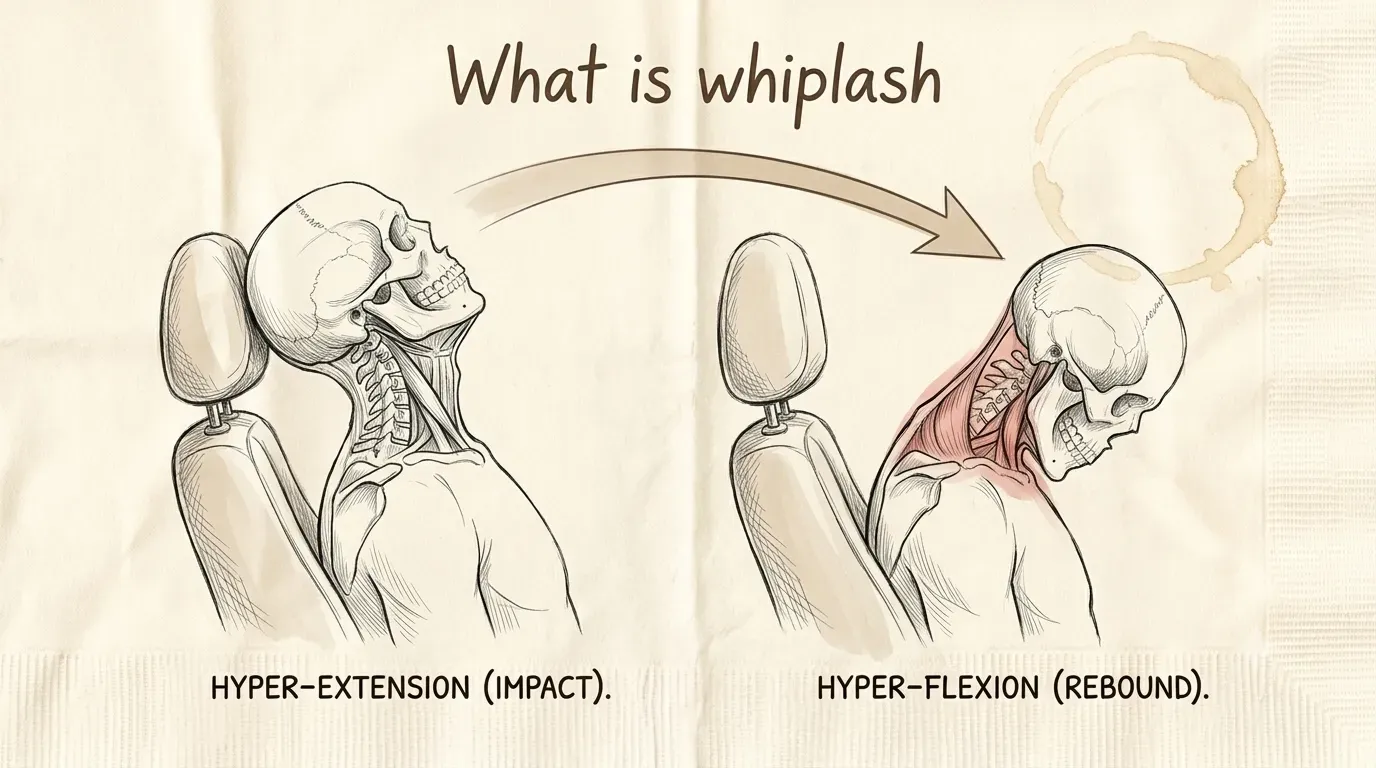
Whiplash is a specific injury, most often from a car accident, where the head is forcefully jerked backward and then forward, straining the neck's soft tissues. Unlike gradual, posture-driven neck pain, whiplash symptoms — neck pain and stiffness, headaches, dizziness, reduced range of motion — often don't appear right away, sometimes taking hours or a day or two to develop.
Whiplash injuries are graded by severity, from mild neck complaints without physical findings through to cases with measurable or neurological signs. Most people improve within a few months, and ICBC's own recovery information notes that most people recover within 12 weeks of a crash. More significant injuries can take longer, and — importantly — how the injury is managed early on genuinely affects the outcome.
What's the best way to recover from whiplash?
Current evidence-based guidance favours early, gentle movement and returning to normal activity as soon as reasonably possible, along with advice, education, and reassurance — rather than resting in a collar or avoiding movement (Wong, Côté et al., OPTIMa Collaboration, Disability and Rehabilitation, 2014). Prolonged immobilisation and collar use are associated with worse, not better, outcomes.
It's also worth knowing that clear, accurate information about the injury — including reassurance that whiplash tissue damage is typically not severe and is expected to settle — is itself associated with better recovery. That's one reason a thorough, clearly explained assessment matters as much as the hands-on treatment.
When does neck pain or a neck injury need urgent care?
Most neck pain, including most whiplash, does not need emergency care. But some symptoms call for immediate medical evaluation rather than a massage appointment:
- Sudden, severe neck pain or headache — especially if it feels like"the worst ever" — with dizziness, double vision, difficulty speaking, or facial numbness. These can indicate a tear in a neck artery (cervical artery dissection) and a risk of stroke.
- Fever with headache and neck stiffness, which can indicate meningitis.
- New numbness, weakness, or loss of coordination in the arms or legs.
- Neck pain after significant trauma — a car accident, fall, or diving injury — should be evaluated promptly.
This is also why gentle, assessment-guided manual therapy is the appropriate approach for most neck pain.
What actually helps with neck pain?
- Manual therapy and exercise have supporting evidence. There is moderate-quality evidence that specific cervical and shoulder-girdle (scapulothoracic) stretching and strengthening reduces pain and improves function in chronic neck pain — while a general, non-specific exercise program does not (Kay, Gross et al., 2012). In other words, the specific exercise matched to your assessment is what matters.
- Massage therapy has moderate evidence. A systematic review found moderate evidence that massage improves neck pain compared with inactive treatments, with less certainty for other outcomes (Cheng & Huang, 2014). It's a reasonable, helpful part of a plan — most effective combined with movement retraining.
- Gentle movement beats prolonged rest. Once the sharpest pain eases, gentle movement supports recovery better than keeping the neck still.
- Addressing posture and the surrounding structures, not just the neck. Long-standing neck pain is frequently driven as much by upper-back mobility and shoulder position as by the neck itself — which is why treatment aimed only at the neck often gives only temporary relief.
How we treat neck pain
A clinical approach that looks beyond the neck
Our assessment is deliberately broad. We look at the neck, but also the upper back, the ribs and shoulder-blade movement — because all of these can drive or maintain neck symptoms.
Reviews of neck pain treatment have found that hands-on treatment on its own doesn't produce lasting benefit, while hands-on treatment combined with exercise does (Gross et al., Cochrane, 2015).
1. Improving mobility and flexibility
Massage, specific stretching, and gentle joint mobilisation, aimed at the tissue and the segments that are actually restricted on assessment — commonly the muscles at the base of the skull, along the top of the shoulders and the side of the neck, and the stiff upper-back segments the neck ends up compensating for.
Where neck pain comes with arm symptoms — tingling, numbness, or a heavy feeling — nerve tissue may be sensitized or restricted in how it moves. Gentle techniques to restore that movement, along the neck, shoulder and arm, are part of the same mobility work.
The purpose is to reduce pain and muscle guarding and give you back range of movement. That relief is genuinely useful, and it's often what makes the rest of the treatment possible — but on its own it tends not to hold. That's why it's the first of three, not the whole plan.
2. Addressing posture and movement patterns that may be contributing
How you hold and move your neck through the day can feed a pain problem — but the relationship is looser than most people assume, and it's worth being straight about that. Studies looking for a simple link between"bad posture" and neck pain have not found a strong one (Richards et al., Physical Therapy, 2016). Plenty of people with what looks like poor posture have no pain at all.
So we don't chase a textbook posture, and we won't tell you to sit up straight. What we look for is more specific: which positions and movements actually provoke your symptoms, whether your neck is doing work your upper back or shoulder blades should be sharing, and whether the deeper muscles that hold your head balanced over your chest are doing their job or leaving it to the big surface muscles that then ache by the afternoon.
The aim is a neck that sits and moves well without you having to hold it there.
3. Strengthening the neck and upper back
This is the part with the strongest evidence behind it, and the part most often skipped.
In a year-long randomised trial of 180 women with chronic neck pain, 73% of those doing neck strength training and 59% of those doing endurance training reported considerable or complete relief, compared with 21% who received advice alone (Ylinen et al., JAMA, 2003). More recent reviews continue to place strengthening — combined with movement retraining — at the top of the list for lasting improvement (Zhang et al., The Spine Journal, 2025).
One caveat matters: it has to be the right exercise. Specific neck and shoulder-girdle strengthening reduces pain and improves function in chronic neck pain, while general, non-specific exercise does not (Kay, Gross et al., Cochrane, 2012). Which is the reason for the assessment.
You'll be given a small number of exercises matched to what the assessment found, progressed as you improve. The aim is that you don't need us indefinitely.
What to Expect
From assessment to self-management
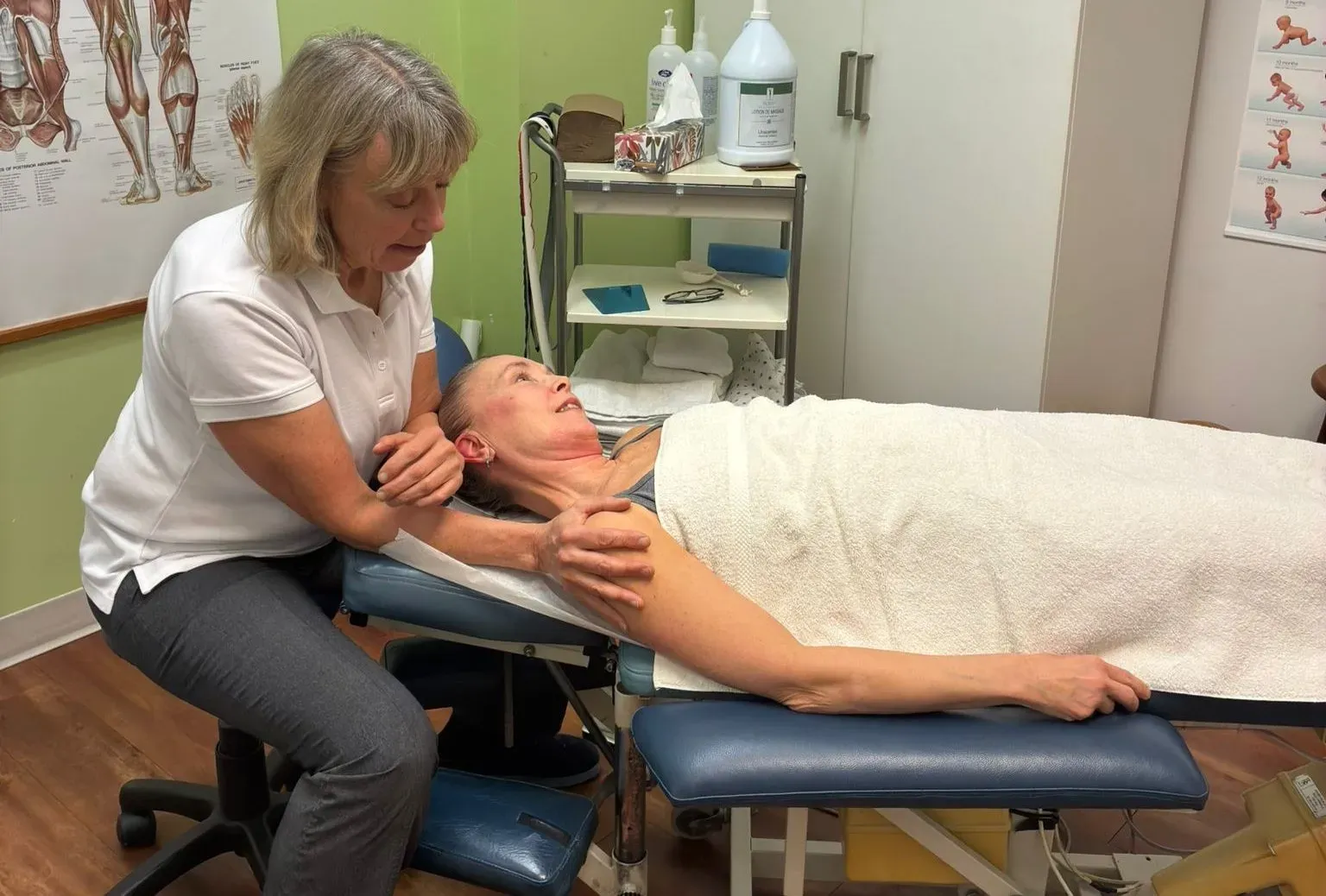
Neck pain treatment typically begins with a 45- 60 minute assessment and treatment session. Eva will explain her findings clearly — what's restricted, what's compensating, and what needs to change.
Many patients with straightforward neck pain improve significantly within three to five sessions. Cases involving nerve symptoms, long-standing postural patterns, whiplash, or jaw-related contributions may take longer. You'll receive an honest timeline based on your assessment.
Between sessions, you'll practise targeted exercises to hold the mobility gains and build strength in the right areas. The aim is independence — not an indefinite treatment schedule.
The Scandinavian Clinic
A clinical approach to neck and upper-body pain
- Swedish-trained orthopaedic manual therapy. Five years of university-level training in Sweden, with a strong emphasis on clinical reasoning and biomechanical assessment.
- Czech-trained DNS therapist. Learn more
- Covered by most insurance plans. As a Registered Massage Therapist, Eva's treatments are eligible for extended health benefits, and ICBC visits following a motor vehicle accident can be arranged.

Frequently asked questions
Can neck pain cause headaches?
Yes. Tight muscles and joint restriction at the base of the skull can produce cervicogenic headaches — distinct from migraine, though the two often overlap. Neck pain is actually a more common migraine symptom than nausea (Calhoun et al., 2010), so telling them apart is important.
How long does whiplash take to heal?
Most people improve within a few months, and ICBC notes most people recover within 12 weeks of a crash. More significant injuries can take longer, and early, active management helps.
Should I rest my neck after a whiplash injury?
Generally no. Current guidance favours early, gentle movement and a return to normal activity over prolonged rest or a collar (Wong et al., 2014).
When should I see a doctor instead of booking massage therapy?
Seek immediate care for sudden severe neck pain or headache with dizziness, double vision, facial numbness, or difficulty speaking; for fever with neck stiffness; or for new numbness or weakness in the limbs. Neck pain after a car accident, fall, or significant trauma should be evaluated promptly.
Is massage therapy safe and effective for neck pain?
For most neck pain, yes. There is moderate evidence that massage improves neck pain compared with inactive treatment (Cheng & Huang, 2014). Gentle, assessment-guided treatment is the appropriate approach.
Does ICBC cover treatment for whiplash from a car accident?
Registered Massage Therapy for whiplash following a motor vehicle accident in BC is commonly covered, though the specific claims process depends on your circumstances. Call the clinic and we can talk you through arranging an ICBC visit.
Schedule Your Visit
Book your appointment for neck pain or whiplash treatment
Persistent neck pain — or a recent whiplash injury — deserves more than stretching advice. Book an RMT assessment to identify the functional movement patterns contributing to your symptoms.
Book Your AssessmentSuite 202-101 West 16th Street, North Vancouver · (604) 926-4883
References
- Kay TM, Gross A, Goldsmith CH, et al. Exercises for mechanical neck disorders. Cochrane Database of Systematic Reviews. 2012;(8):CD004250.
- Cheng YH, Huang GC. Efficacy of massage therapy on pain and dysfunction in patients with neck pain: a systematic review and meta-analysis. Evidence-Based Complementary and Alternative Medicine. 2014;2014:204360.
- Calhoun AH, Ford S, Millen C, et al. The prevalence of neck pain in migraine. Headache. 2010;50(8):1273–1277.
- Wong JJ, Côté P, Shearer HM, et al. Clinical practice guidelines for the management of conditions related to traffic collisions (OPTIMa Collaboration). Disability and Rehabilitation. 2014;37(6):471–489.
- Biller J, Sacco RL, Albuquerque FC, et al. Cervical arterial dissections and association with cervical manipulative therapy: AHA/ASA scientific statement. Stroke. 2014;45(10):3155–3174.
- Kobesová A, Kolář P. Developmental kinesiology: three levels of motor control in the assessment and treatment of the motor system. Journal of Bodywork and Movement Therapies. 2014;18(1):23–33.
- Gross A, Langevin P, Burnie SJ, et al. Manipulation and mobilisation for neck pain contrasted against an inactive control or another active treatment. Cochrane Database of Systematic Reviews. 2015;(9):CD004249.
- Ylinen J, Takala EP, Nykänen M, et al. Active neck muscle training in the treatment of chronic neck pain in women: a randomized controlled trial. JAMA. 2003;289(19):2509–2516.
- Zhang Y, et al. Comparative efficacy of exercise versus passive physical therapy in improving nonspecific neck pain: a multilevel network meta-analysis and dose-response analysis. The Spine Journal. 2025.
- Richards KV, Beales DJ, Smith AJ, et al. Neck posture clusters and their association with biopsychosocial factors and neck pain in Australian adolescents. Physical Therapy. 2016;96(10):1576–1587.
- Blanpied PR, Gross AR, Elliott JM, et al. Neck pain: revision 2017. Clinical practice guidelines. JOSPT. 2017;47(7):A1–A83.
Written by Eva Andersson, RMT · Last updated July 2026