What Is Dynamic Neuromuscular Stabilisation?
What is DNS?
Dynamic Neuromuscular Stabilisation (DNS) is a movement assessment and training approach developed at the Prague School of Rehabilitation Medicine in the Czech Republic.
DNS is based on developmental kinesiology — the study of how movement and postural control develop during infancy. The central idea is simple: Before we learn to walk, run, lift or play sport, we first learn how to stabilise and control our body. DNS uses these early developmental patterns as a reference for assessing and training movement in adults.Book Your Assessment
All treatment is provided within Registered Massage Therapy and is eligible for coverage under most BC extended health plans.
Why look at how babies move?
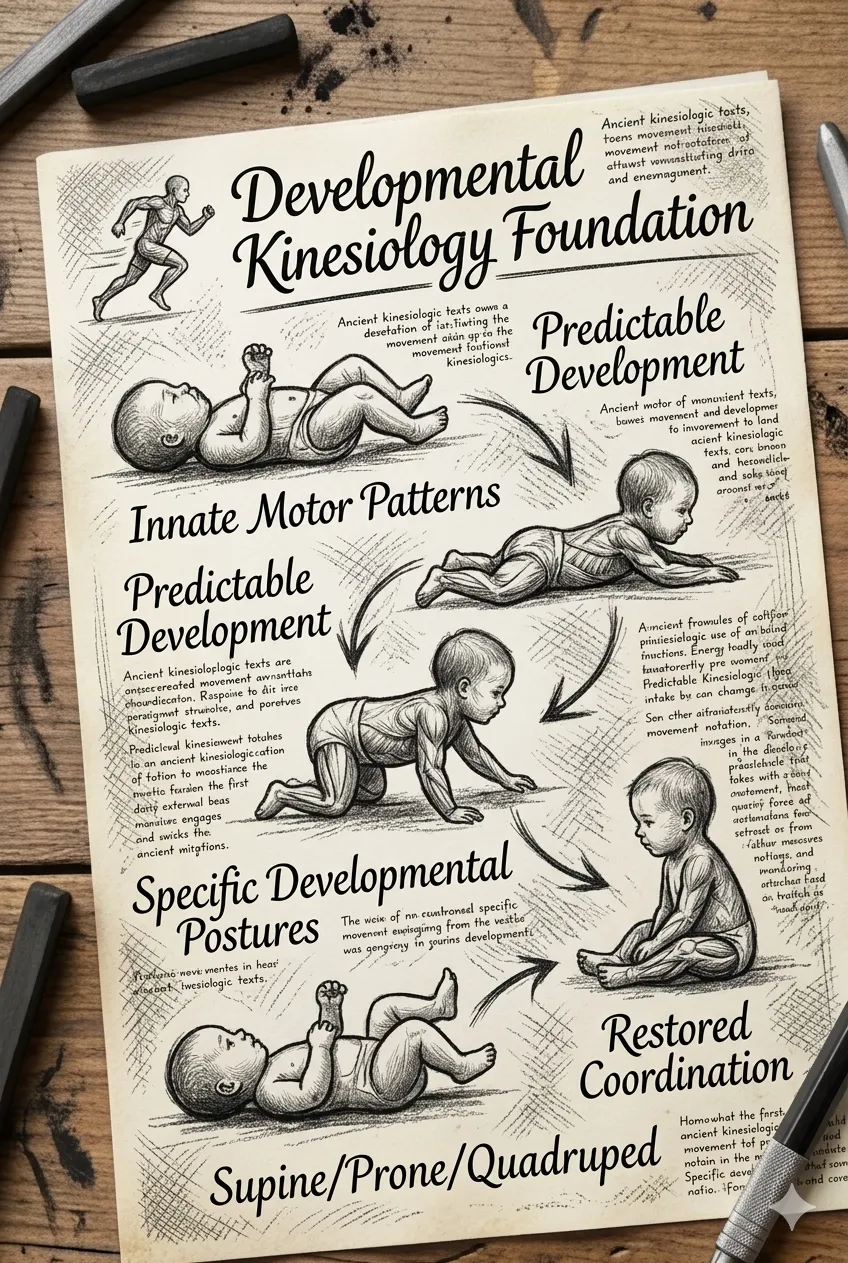
Nobody teaches a healthy baby how to stabilise its trunk. As the nervous system matures, movement develops through a remarkably organised sequence. A baby learns to:
- control the head
- roll
- reach
- support itself
- sit
- move through four-point positions
- stand
- walk
Each stage requires increasingly sophisticated coordination of the trunk and limbs. These aren't just milestones. They are stages in the development of movement and postural control. DNS uses this developmental process as a reference.
The patterns are not simply exercises
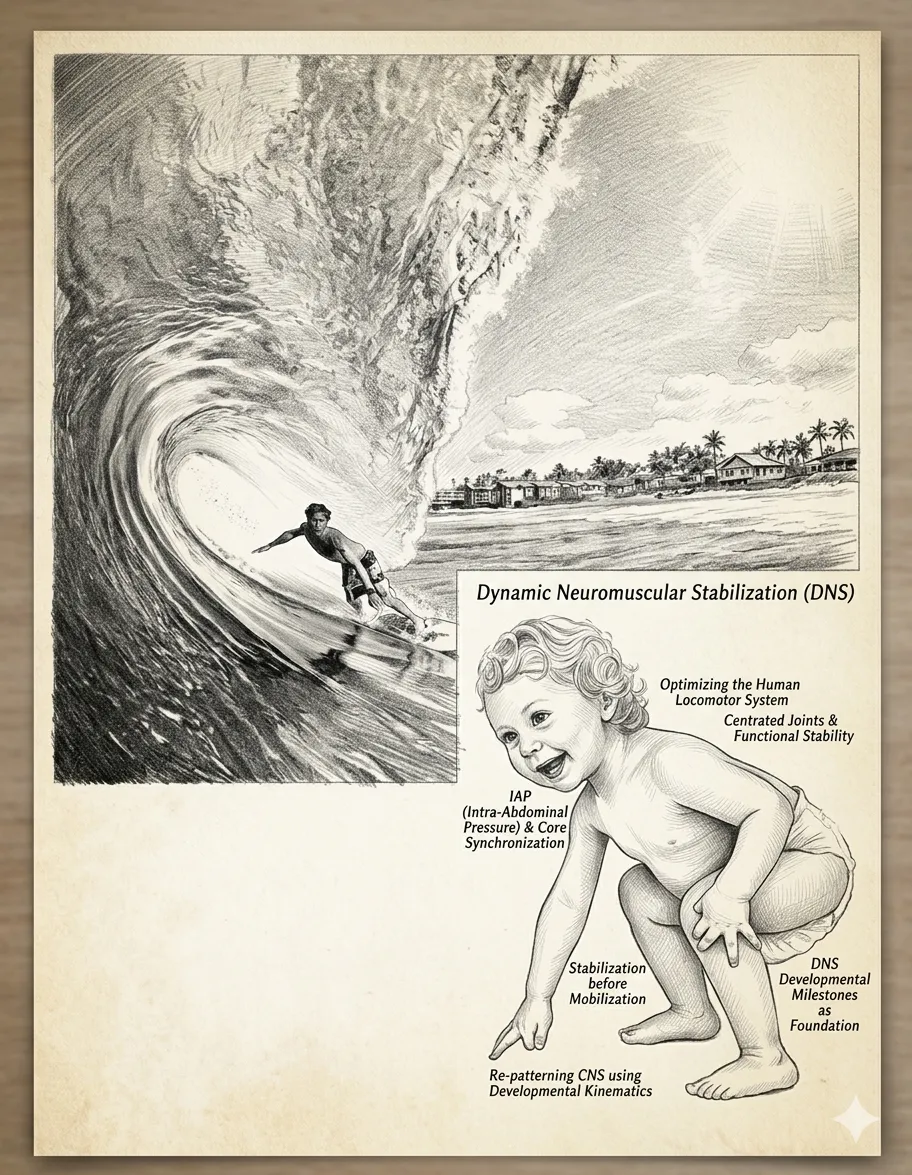
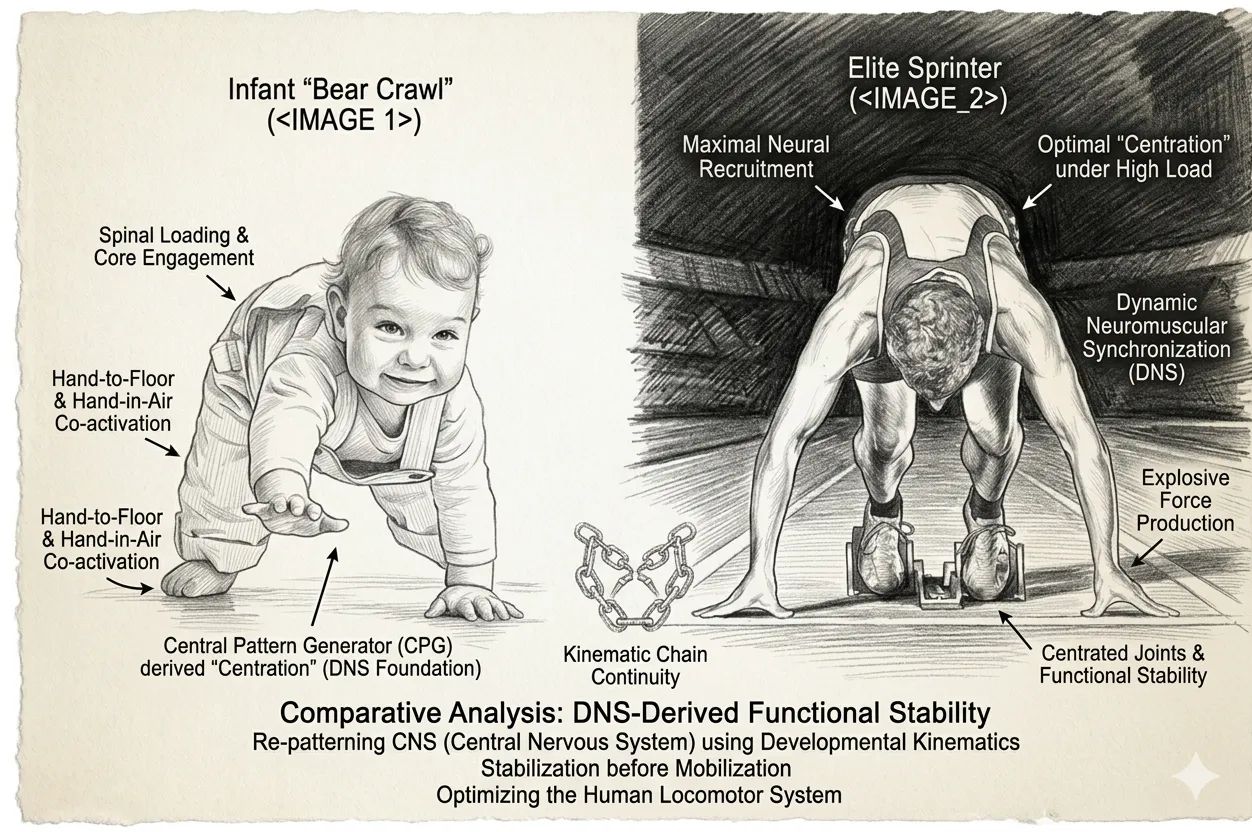
You may see DNS exercises that look like positions from infancy. That is intentional. But the purpose isn't to make an adult"exercise like a baby." The position is used because it provides a particular movement and stabilisation challenge. The therapist is looking at how you organise your body within that position:
- how the trunk stabilises
- how the limbs move
- how the ribcage and pelvis relate
- how breathing is integrated
- where unnecessary tension appears
- whether the movement can be controlled without compensation
The position is the starting point. The pattern is what matters.
What happens when we lose an efficient pattern?
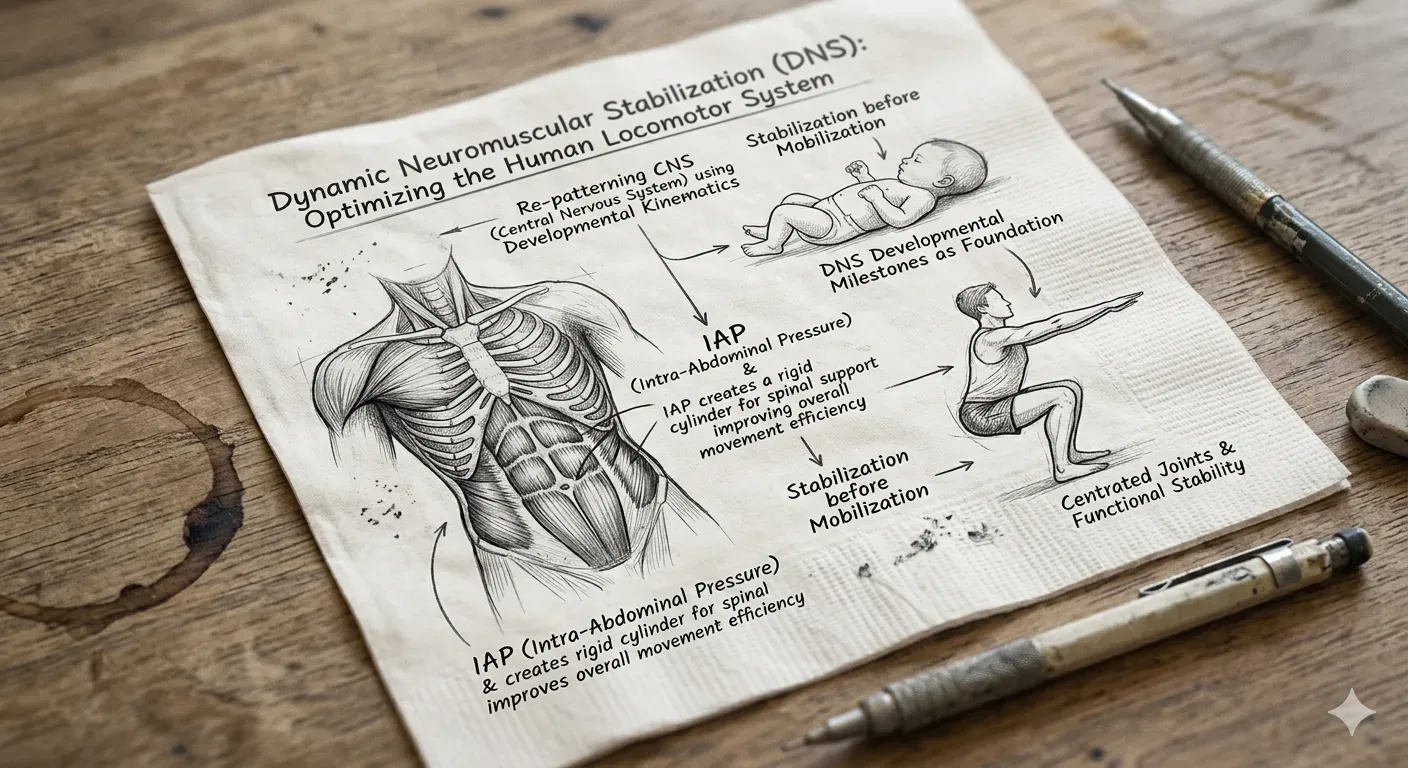
Movement changes throughout life. Pain, injury, restricted mobility, inactivity, repetitive activity and other factors can influence how we move. The body adapts.
Sometimes an adaptation becomes the movement strategy we use most often. It may work perfectly well for a while. But under greater demand — fatigue, speed, load or repetition — the compensation may become more apparent.
DNS asks whether some of these movement strategies can be improved by returning to more fundamental patterns of stabilisation and control.
The goal isn't to make you consciously control everything
A common misunderstanding is that DNS means learning a complicated set of instructions: "Activate this muscle." "Hold this position." "Breathe this way." That's not the end goal.
Conscious attention can be useful while learning. But the nervous system normally controls movement automatically. The aim is therefore to practise the pattern until less conscious attention is needed. You learn it first. With repetition, the body can begin to use it more naturally.
What does a DNS assessment look at?
DNS is not simply a collection of exercises. It begins with assessment. The therapist looks at how you organise movement in different positions and during different tasks. Depending on your situation, this can include:
- Trunk stabilisation: How well can you support your body while allowing the limbs to move?
- Breathing: Can breathing remain coordinated with stabilisation?
- Ribcage and pelvis: How are these regions positioned and how do they respond during movement?
- Joint mobility: Are restrictions preventing you from performing the movement effectively?
- Muscle activity: Are some muscles working excessively or compensating for others?
- Movement quality: Can the pattern be maintained when movement becomes more demanding?
Why the exercises are often surprisingly simple
DNS exercises usually begin with relatively simple positions. That is deliberate. If the movement pattern cannot be organised at low load, adding more weight or complexity may simply make the compensation stronger.
The therapist therefore starts where you can control the movement. Then the demands increase. For example: simple position → controlled movement → greater range → resistance → speed → functional movement.
The exact progression depends on the person and the problem.
What does the therapist actually do?
The therapist observes how you move and may use hands-on guidance to help you find a more effective position or movement. This can be surprisingly subtle. You may feel that you are doing the exercise correctly while your body is actually using a familiar compensation. A hand on the ribcage, pelvis or abdomen can give you information that is difficult to obtain from a mirror.
The purpose isn't for the therapist to"put" the correct movement into you. The therapist helps you experience it. You then have to reproduce it yourself.
Practice is what makes the difference
A treatment session can give you a new experience of movement. But one session cannot do all the learning for you. The nervous system needs repetition.
That's why home practice is an important part of DNS. The exercises are generally simple enough to practise regularly, often for a short period each day. The goal isn't to spend hours exercising. It is to give the nervous system enough good repetitions to make the new pattern increasingly familiar.
DNS and strength training
DNS is not a replacement for strength training. Strength matters. So do endurance, mobility, cardiovascular fitness, speed and sport-specific skills.
DNS addresses a different part of the problem: How is the body organising movement and stabilisation? Once coordination is established, strength and conditioning can be progressively added. The two approaches can work very well together.
DNS and manual treatment
DNS doesn't mean that manual treatment is unnecessary. If a joint is restricted or a muscle is excessively active, it may be difficult to perform a new movement pattern effectively.
Manual treatment can sometimes help create the movement that the patient then needs to learn and use. This is consistent with a broader Prague School approach associated with clinicians such as Karel Lewit and Vladimir Janda: create the conditions for better movement, then actively retrain the movement.
Where DNS came from
DNS was developed at the Prague School of Rehabilitation Medicine in the Czech Republic. It grew from the Prague School's broader work in rehabilitation, manual medicine, movement control and developmental kinesiology. Professor Pavel Kolář has been one of the central figures in the development of DNS. The approach sits within a broader Czech rehabilitation tradition associated with clinicians including:
- Prof. Karel Lewit
- Prof. Vladimir Janda
- Prof. Pavel Kolář
- and other Prague School clinicians and researchers
The approaches are not identical, but they share an emphasis on functional movement, coordination and the relationship between the nervous system and the musculoskeletal system.
Who can benefit from DNS?
DNS is not a treatment for one particular diagnosis. It may be useful when movement coordination or stabilisation is relevant to:
- recurring musculoskeletal problems
- recovery after injury
- persistent movement limitations
- difficulties translating strength into movement
- sport enhancement and performance
- postural control
- movement that feels inefficient or unstable
You don't need to be an athlete. And you don't need to be in pain. The question is whether DNS principles are relevant to your particular movement problem.
Frequently Asked Questions
Is DNS the same as physiotherapy?
No. DNS is an approach or training system rather than a profession. Clinicians from different professional backgrounds can train in DNS. At Scandinavian Clinic, DNS principles are used within Registered Massage Therapy, alongside manual assessment and treatment.
Is DNS the same as Pilates or core training?
No, although there can be overlap. Pilates and conventional core training can develop strength, endurance and movement control. DNS places particular emphasis on developmental movement, stabilisation and coordination. They are not mutually exclusive. In many cases, strength and conditioning can be added once the movement pattern is established.
Do I need to be in pain?
No. DNS can be used for rehabilitation, movement quality and performance as well as for people experiencing pain. The aim is to improve how your body organises movement, not simply to treat a painful area.
Are the exercises difficult?
They often look easy. That can be misleading. The challenge isn't necessarily how much weight you lift or how many repetitions you complete. The challenge is maintaining the intended movement and stabilisation pattern while breathing and moving. Quality matters more than quantity.
Do I have to do DNS forever?
No. The aim is not to create a permanent dependence on exercises or treatment. The purpose of practice is to make the movement pattern increasingly familiar and automatic. Once a movement can be integrated into normal activity, training can progress toward the demands of your everyday life, work or sport.
The Scandinavian Clinic
- Czech-trained in Dynamic Neuromuscular Stabilisation, at the Prague School of Rehabilitation Medicine.
- DNS is used as part of a broader clinical assessment, rather than as a one-size-fits-all exercise programme.
- Manual treatment is used when restrictions or excessive muscle activity interfere with movement.
- Active practice is central. The patient has to learn and reproduce the movement.
- Strength and conditioning can be added as movement control improves.
- Treatment is provided as Registered Massage Therapy and is covered by most extended health plans.
The key idea
DNS is not about copying how a baby moves. It is about understanding how movement control develops, using those developmental patterns as a reference, and helping an adult regain more effective ways of organising stability and movement. The therapist can guide the process. But the nervous system has to learn it.
Schedule Your Assessment
If you would like to understand whether DNS may be relevant to your movement, pain or performance, the first step is an assessment.Book Your AssessmentSuite 202-101 West 16th Street, North Vancouver · (604) 926-4883
Written by Eva Andersson, RMT · Last updated August 2026