Sciatica Treatment in North Vancouver
What is sciatica, and what causes it?
Sciatica is pain caused by irritation or compression of the sciatic nerve; it can travel from the lower back or through the buttock down the leg, sometimes to the foot. Most cases improve with conservative (non-surgical) care over a few weeks to a few months.
The cause matters: true nerve root irritation, a tight piriformis muscle, and hip- or joint-referred pain can feel similar but need different treatment — which is why a thorough assessment comes first.
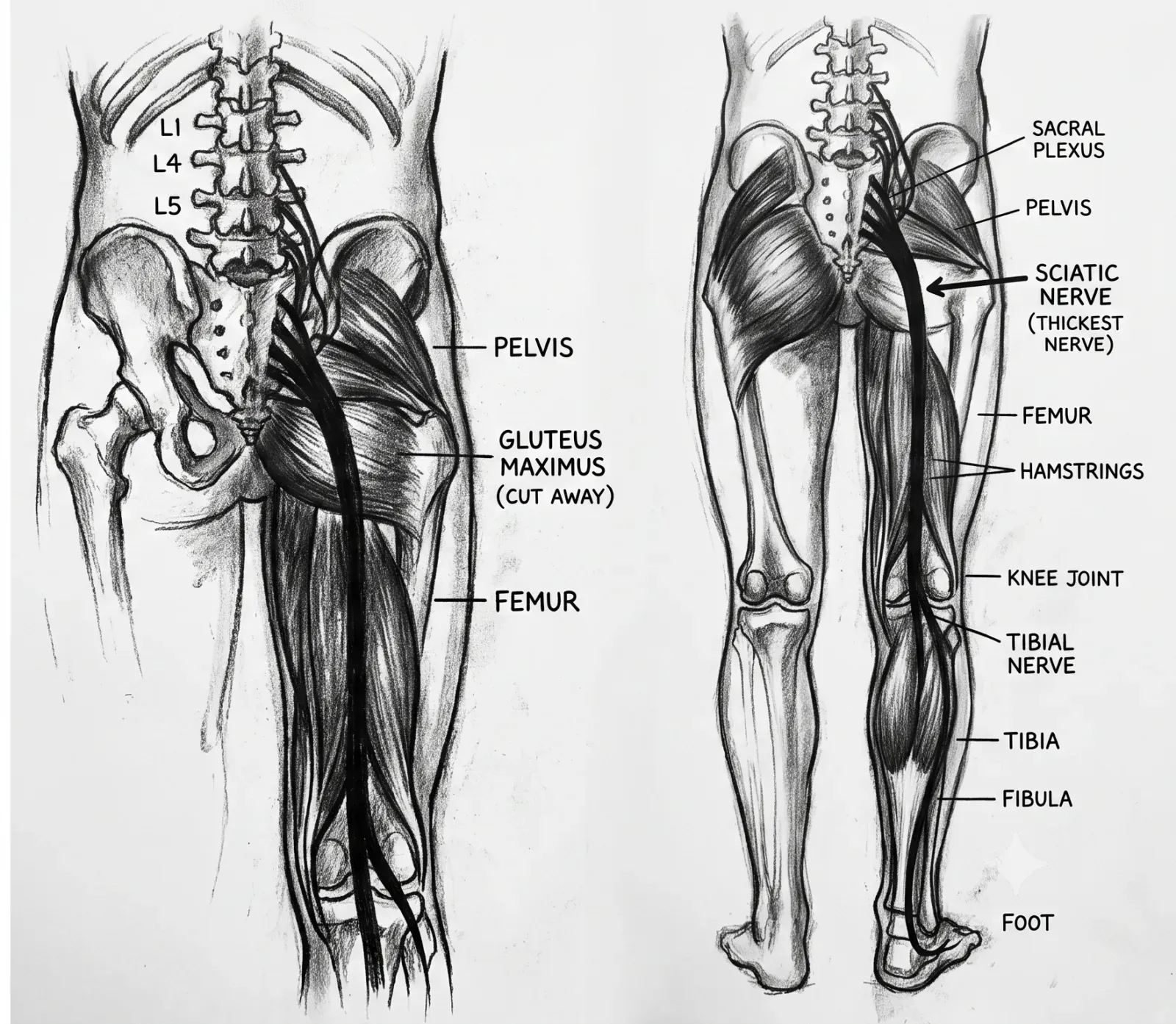
Typical Symptoms with Sciatica: A sharp, burning, or electric pain that shoots from your lower back or buttock down into your leg — sometimes all the way to your foot. Sitting becomes the worst position. Driving is miserable. Sciatica has a recognisable pattern [1], though the exact cause varies from person to person:
- Radiating pain. Often a burning, shooting, or electric pain that starts in the lower back or buttock and travels down the back or outside of the thigh and leg, sometimes into the foot.
- Numbness, tingling, or weakness. The pain may come with numbness down the leg,"pins and needles," or a sense of weakness in the leg or feet.
- Usually one-sided. Sciatica typically affects one leg, often with a feeling of heaviness in it. Symptoms in both legs are less common. If you develop loss of bladder or bowel control, numbness, or rapidly worsening leg weakness, that's a red flag needing emergency care (see below).
- Position-dependent — and the pattern points to the cause. Which positions ease or worsen it depends on why the nerve is irritated: disc-related sciatica often worsens with sitting, bending forward, or coughing, while spinal stenosis-related symptoms tend to worsen with walking and ease when sitting or leaning forward. Noticing your pattern is part of identifying the cause.
What makes sciatica particularly frustrating is the uncertainty. Is it a disc? Is it permanent? Will it come back? At Scandinavian Clinic, we assess where and why your sciatic nerve is being irritated and address the contributing factors — not just the pain travelling down your leg.
Understanding Sciatica
Is it true sciatica — and why that matters
Sciatica describes pain that follows the path of the sciatic nerve — the largest nerve in your body, running from the lower spine through the buttock and down each leg. The pain is a symptom, not a diagnosis. What matters is why the nerve is irritated, because different causes require different treatment.
Pain from the hip joint, sacroiliac joint, or referred muscle pain (common with general lower back pain) can closely mimic sciatic symptoms. Accurate assessment matters because nerve-root irritation calls for a different treatment approach than muscle-referred pain that can mimic it.
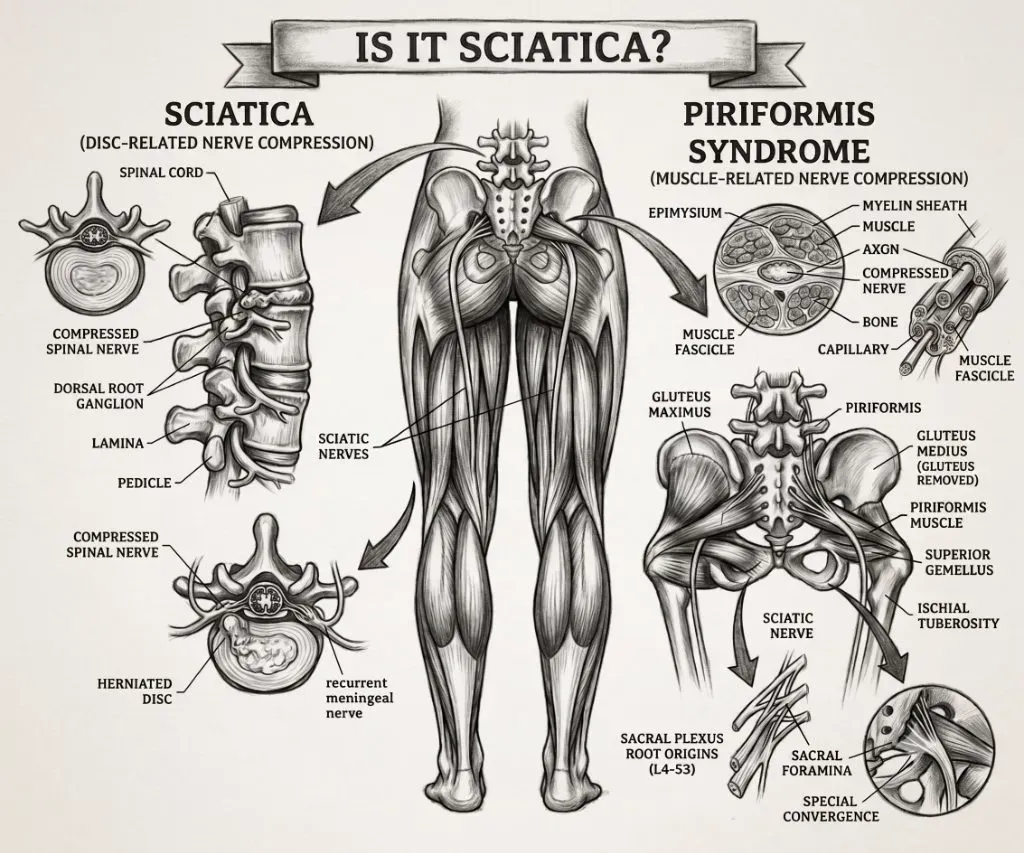
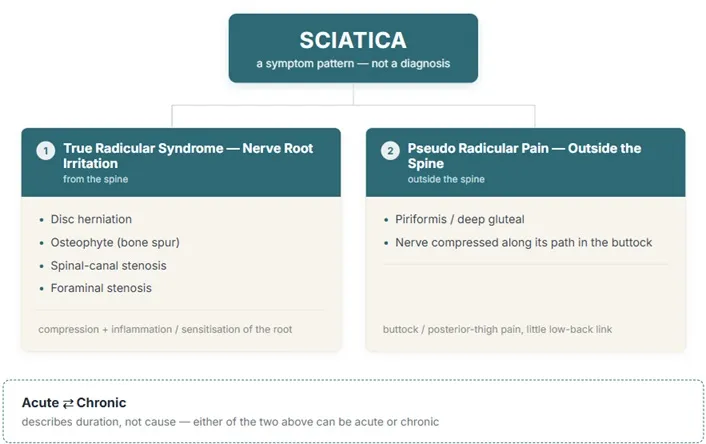
Common causes of sciatic nerve irritation:
- Disc-related compression. A bulging or herniated disc in the lower lumbar spine presses on a nerve root. Often produces pain that worsens with sitting, bending forward, or coughing and sneezing, and may include numbness or tingling in a specific area down the leg which can go into the foot [1].
- Spinal stenosis. Narrowing of the nerve channel, more common in older adults. Typically produces leg symptoms during walking that ease when sitting or leaning forward [2].
- Piriformis-related irritation. The sciatic nerve passes through or beside the piriformis muscle deep in the buttock. When this muscle tightens or spasms, it can compress the nerve — producing buttock and leg pain without significant lower back involvement [3].
- Neural sensitization. Sometimes the nerve itself becomes hypersensitive — because of how it moves and responds mechanically in relation to the surrounding tissue. This may require a different treatment approach (Butler; Shacklock) [4, 5].
When should sciatica be seen urgently?
Most sciatica is not an emergency and responds well to conservative care. But a small number of warning signs need prompt or immediate medical attention rather than a scheduled appointment.
Seek assessment promptly if you have:
- Pain radiating below the knee
- Numbness or tingling in the leg or foot
- Weakness in the leg muscles (for example, difficulty lifting your foot)
Go to the emergency department immediately if you have:
Sudden loss of bladder or bowel control, numbness in the groin or inner thighs (saddle numbness), or rapidly worsening weakness in one or both legs. These can be signs of cauda equina syndrome — rare, but a genuine surgical emergency that needs urgent care.
Outside of these red flags, there is no need to panic about a diagnosis of sciatica itself — it is very treatable.
What actually helps with sciatica?
The large majority of sciatica improves without surgery, and the natural course is generally favourable [6]. A few approaches have the most consistent support:
- Staying active, within reason. For most people, staying as active as symptoms allow leads to similar or better outcomes than prolonged rest, and long periods of inactivity tend to prolong symptoms rather than settle them.
- Movement-based rehabilitation. Supervised exercise therapy — directional exercises, motor-control/stabilisation work, and nerve-mobilisation techniques — is a core part of first-line physiotherapy management for sciatica [7]. It's worth being straight about the evidence: physiotherapy is widely used as first-line care, but the trials are heterogeneous and the overall certainty is still limited [8]. In practice, these approaches tend to work best when guided at first, because technique and progression matter.
- Manual therapy and soft-tissue treatment. Hands-on treatment, including massage, may help reduce the muscle tension and restriction that contribute to nerve irritation. The research on massage specifically is mixed in quality — some studies show measurable benefit for pain and range of motion, while broader reviews call for more rigorous trials [9]. In practice, that makes it a reasonable and often helpful part of a broader plan, particularly alongside movement retraining — not a standalone cure.
- Addressing the underlying pattern, not just the symptom. Because sciatica often develops from a combination of factors — spinal mechanics, muscle imbalance, and movement habits — treatment aimed only at the painful area may give temporary relief without resolving what irritated the nerve in the first place [10]. This is why an assessment that looks at proper core function may give more lasting results.
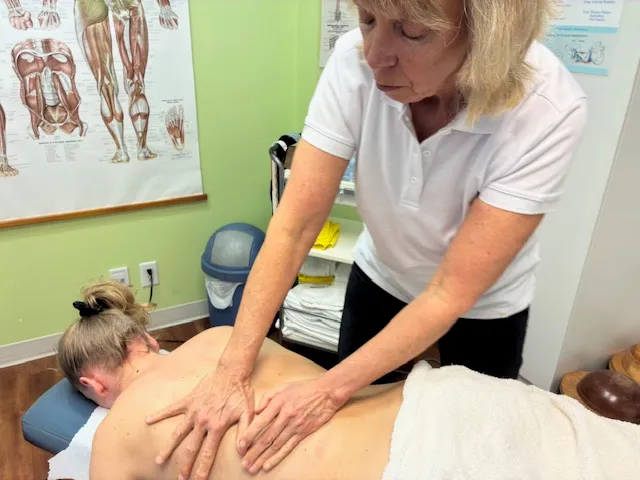
How We Treat Sciatica
Finding where the nerve is irritated — and why
Our assessment works to identify the specific mechanism irritating the nerve. This matters because treating a disc-related sciatica the same way as a piriformis-related one tends to produce inconsistent results.
- Lumbar spine mobilisation — reducing nerve compression. When disc-related or stenotic causes are identified, manual therapy targets the relevant spinal segments to reduce compression and improve spinal mobility — combined with positional strategies (specific positions and movements that reduce nerve loading) you can use at home for pain management.
- Piriformis & deep hip rotator treatment — releasing the buttock muscles. When the buttock muscles are compressing or irritating the nerve, targeted soft-tissue massage work releases the piriformis and surrounding structures. But release alone might not be enough — the reason the piriformis tightened must also be addressed.
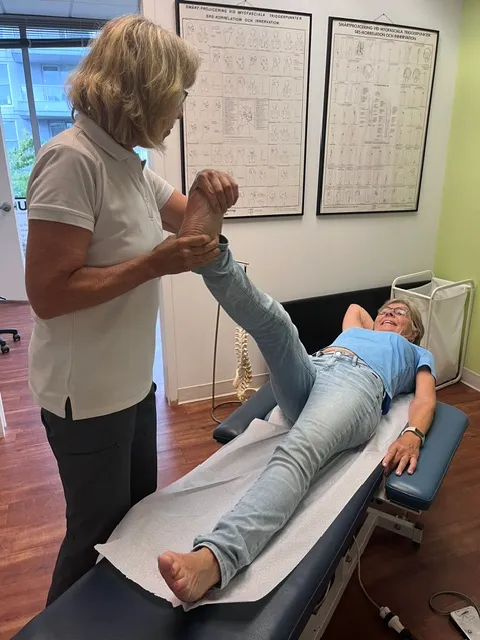
- Neurodynamic assessment & treatment — restoring nerve mobility. Neurodynamic testing is a specific clinical skill: it identifies where along the nerve pathway restriction or sensitivity exists. Treatment then uses precise, gentle techniques to restore normal nerve mobility — the nerve needs to glide and lengthen freely through the surrounding tissues. When it can't, pain can persist even after the original cause has improved.
- DNS for spinal stability — supporting long-term resolution. Sciatica frequently recurs because the underlying spinal instability that allowed the nerve irritation hasn't been addressed. Dynamic Neuromuscular Stabilization (DNS) retrains the core — to provide genuine spinal support, drawing on the developmental-kinesiology basis of the method [11]. It is often part of both short-term relief and long-term resolution. Learn more about DNS →
What to Expect
Treating the whole movement system, not just the pain
Eva will explain what she finds during your clinical assessment, what's possibly causing the nerve irritation, and what a realistic recovery timeline looks like for your situation. If imaging or another practitioner's input is warranted, she'll suggest consulting your physician.
Home management is important, particularly in an acute situation. You'll learn which positions and movements reduce nerve loading and which aggravate it — this knowledge is very important in the early stages of recovery.
The Scandinavian Clinic
Registered Massage Therapy
- Swedish-trained orthopaedic manual therapy. Five years of university-level training in Sweden, with a strong emphasis on clinical reasoning and biomechanical assessment.
- Czech-trained DNS therapist. Sciatica recurrence is closely tied to spinal stability; DNS addresses this at a deep level by retraining the core stabilisation system. Learn more
- Clinical distinction. Differentiating the radicular pain from pseudo radicular pain requires specific testing — and a different treatment plan for each.
- Covered by most insurance plans. As a Registered Massage Therapist, Eva's treatments are usually eligible for extended health benefits.

Frequently asked questions
Is sciatica the same as a slipped disc?
Not exactly. A herniated or bulging disc is one cause of sciatica, but"sciatica" describes the resulting nerve-pain pattern rather than the disc problem itself. Spinal stenosis, piriformis-related irritation, and a sensitized nerve can, at times, all produce similar symptoms.
How do I know if my leg pain is sciatica or something else, like piriformis syndrome?
The location and pattern of pain, plus specific movement and positioning tests, help tell a spinal cause apart from a muscular one such as piriformis-related irritation. An in-person assessment is the most reliable way to know — the two can feel almost identical but respond to different treatment.
Can massage by itself help with sciatica?
Massage may help reduce the muscle tension and restriction that contribute to nerve irritation, and some studies show benefits for pain and mobility [9]. It's generally most effective as part of a broader plan that includes movement-based rehabilitation, rather than on its own.
Should I rest or stay active with sciatica?
For most people, staying as active as symptoms allow is better than prolonged rest, which tends to prolong symptoms. Your assessment will include which specific positions and movements reduce nerve loading for you.
When should I see a doctor instead of booking an appointment?
If leg pain comes with new bladder or bowel changes, saddle numbness, or weakness in both legs, seek emergency care immediately. Outside of those red flags, sciatica is very treatable with conservative care.
How many sessions will it take?
It depends on the cause and how long symptoms have been present. After the initial visit, we can usually give you a realistic estimate.
Schedule Your Visit
Book your RMT assessment for sciatica
Sciatica responds best to treatment that targets the right cause. Book an assessment to find out exactly where and why your nerve is being irritated.
Schedule Your AssessmentSuite 202-101 West 16th Street, North Vancouver · (604) 926-4883
References
- Jensen RK, Kongsted A, Kjaer P, et al. Diagnosis and treatment of sciatica. BMJ. 2019.
- Katz JN, Zimmerman ZE, Mass H, et al. Diagnosis and management of lumbar spinal stenosis: a review. JAMA. 2022.
- Hopayian K, Song F, Riera R, et al. The clinical features of the piriformis syndrome: a systematic review. Eur Spine J. 2010.
- Butler DS. The Sensitive Nervous System. 2000.
- Shacklock M. Clinical Neurodynamics. 2005.
- Vroomen PCAJ, de Krom MCTFM, Slofstra PD, Knottnerus JA. Conservative treatment of sciatica: a systematic review. Journal of Spinal Disorders. 2000;13(6):463–469.
- Ostelo RWJG. Physiotherapy management of sciatica. Journal of Physiotherapy. 2020;66(2):83–88.
- Dove L, Jones G, Kelsey LA, Cairns MC, Schmid AB. How effective are physiotherapy interventions in treating people with sciatica? A systematic review and meta-analysis. European Spine Journal. 2023;32(2):517–533.
- Kumar S, Beaton K, Hughes T. The effectiveness of massage therapy for the treatment of nonspecific low back pain. International Journal of General Medicine. 2013;6:733–741.
- Frank C, Kobesova A, Kolar P. Dynamic neuromuscular stabilization & sports rehabilitation. Int J Sports Phys Ther. 2013.
- Kobesová A, Kolář P. Developmental kinesiology: three levels of motor control in the assessment and treatment of the motor system. Journal of Bodywork and Movement Therapies. 2014;18(1):23–33.
Written by Eva Andersson, RMT · Last updated July 2026