Tennis Elbow Treatment in North Vancouver
Tennis elbow is pain on the outside of the elbow, felt most when you grip or twist. Those movements provoke the pain — but that painful area is usually not where the problem started. Commonly the elbow is the end point of a functional disturbance elsewhere: shoulder girdle function, cervical spine, wrist mechanics Which is why treatment aimed only at the elbow so often stalls.
You don't need to play tennis. Gripping a coffee mug, turning a doorknob, using a mouse, lifting, holding a paint roller — these are the movements that bring the pain on. It starts as an annoyance and escalates until you're dropping things and changing how you use your hand.
Most people are then told the same thing: it's the tendon, rest it, brace it, do these wrist exercises. For some, that works.
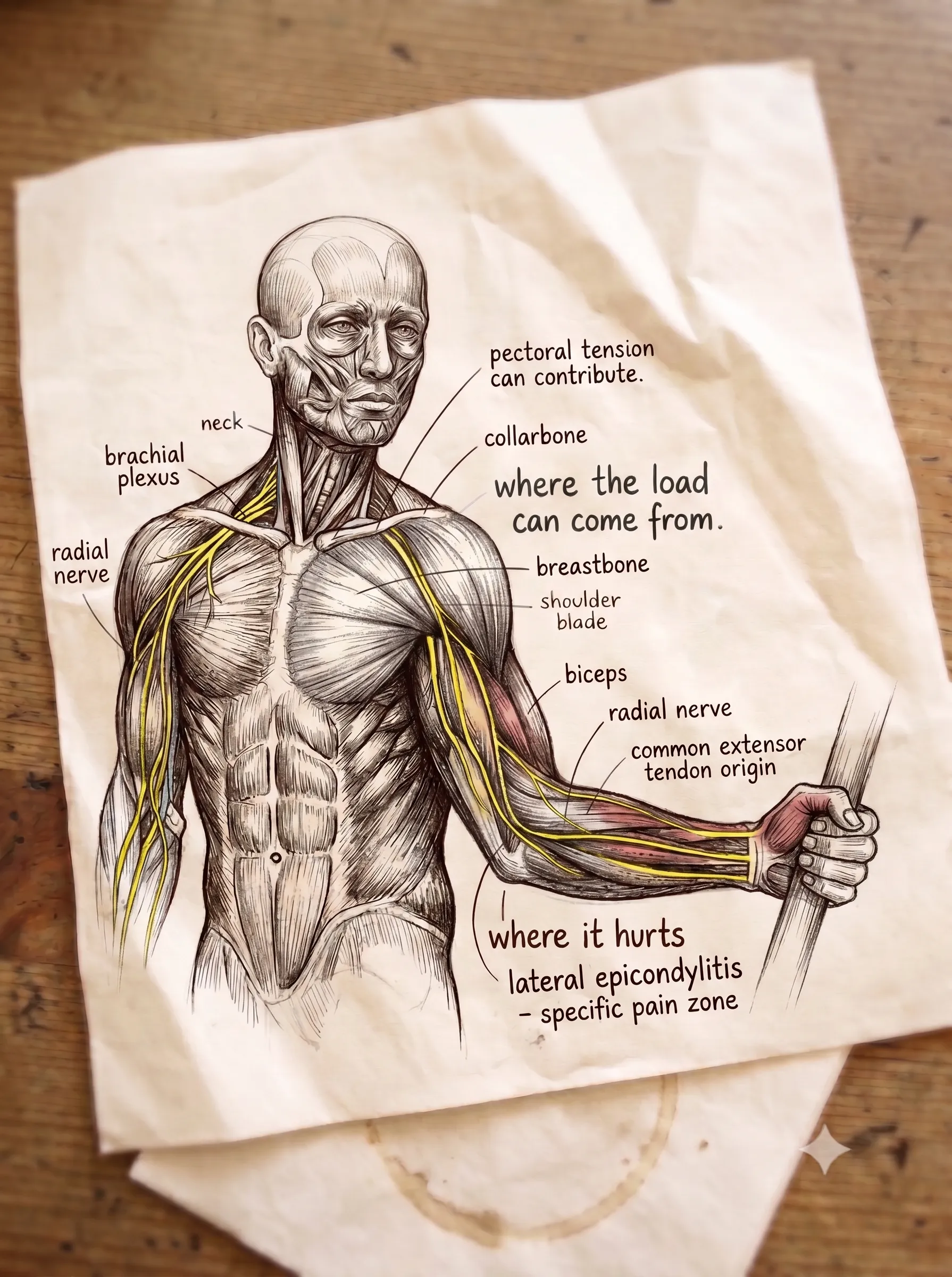
Common symptoms:
- Pain on the outside of the elbow, worst when gripping or lifting with the palm down
- Weak grip — dropping things, trouble opening jars
- Pain with repeated wrist movement — typing, tools, cooking
- Tenderness over the bony point on the outside of the elbow
- Aching or tightness through the forearm toward the wrist
- Sometimes tingling, numbness, or a heavy feeling in the forearm or hand
When to seek treatment: if elbow pain has lasted more than three or four weeks despite rest, if a brace hasn't helped, or if grip weakness is affecting your work or daily activities.
Why the pain is at the elbow
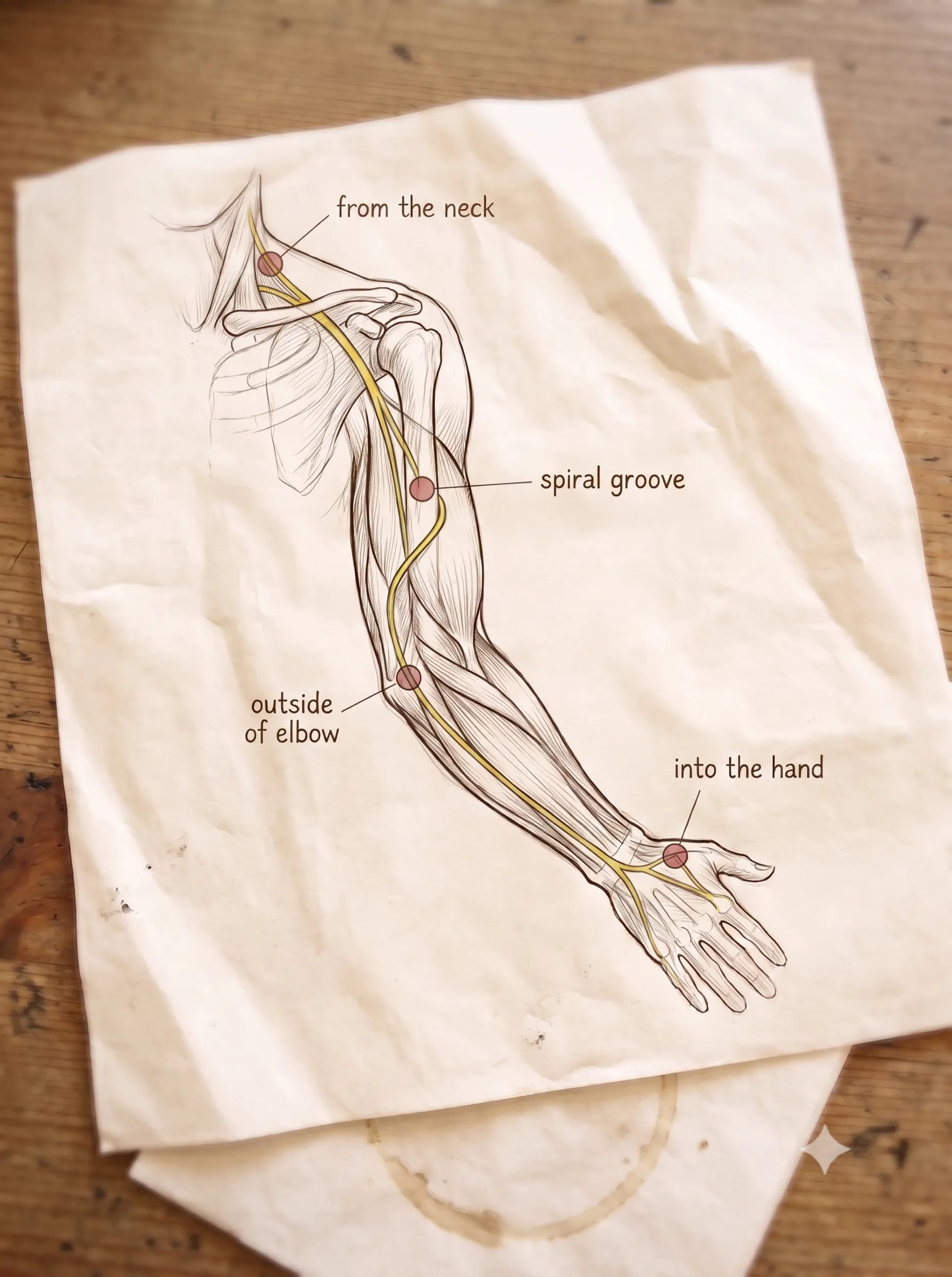
Karel Lewit, one of the founders of the Prague School of Rehabilitation Medicine, treated lateral elbow pain as the end result of dysfunction elsewhere rather than as a local injury. In his approach, the regions to examine are:
- the cervical spine, particularly the C5–C7 segments
- the shoulder and how the shoulder blade moves and holds position
- the thoracic spine and ribs
- the wrist and forearm, and how their muscles coordinate
The elbow is examined too — but as one link, and often not the decisive one.
What examination finds. In a case-control study of 165 people with tennis elbow, more than a third had measurable dysfunction in the cervical spine and 41% had a positive nerve-tension test for the radial nerve — in a group selected to exclude anyone reporting neck or arm symptoms (Coombes et al., JMPT, 2014). These findings are usually silent. They show up on examination, not in the patient's account of their problem.
The nerve. The radial nerve runs from the neck, spirals behind the upper arm, and passes the outside of the elbow on its way to the hand. Ultrasound imaging shows it is measurably thicker and more sensitive to pressure along its course in people with tennis elbow than in people without (Cancela-Cilleruelo et al., Diagnostics, 2023). Where the nerve is involved, it produces pain that behaves like tendon pain.
Treatment above the elbow changes the elbow. In a placebo-controlled, double-blind trial, a single treatment applied to the neck immediately increased pain-free grip strength in the affected hand (Vicenzino et al., Pain, 1996). In a sham-controlled trial, a single two-minute mobilisation of the mid-back increased pain-free grip strength by an average of 4.4 kg (Zunke et al., BMC Musculoskeletal Disorders, 2020).
This is Lewit's central point in practice: the site of the pain and the site of the disturbance are frequently not the same place. So the examination starts away from the elbow and works toward it.
Dysfunction in the movement system
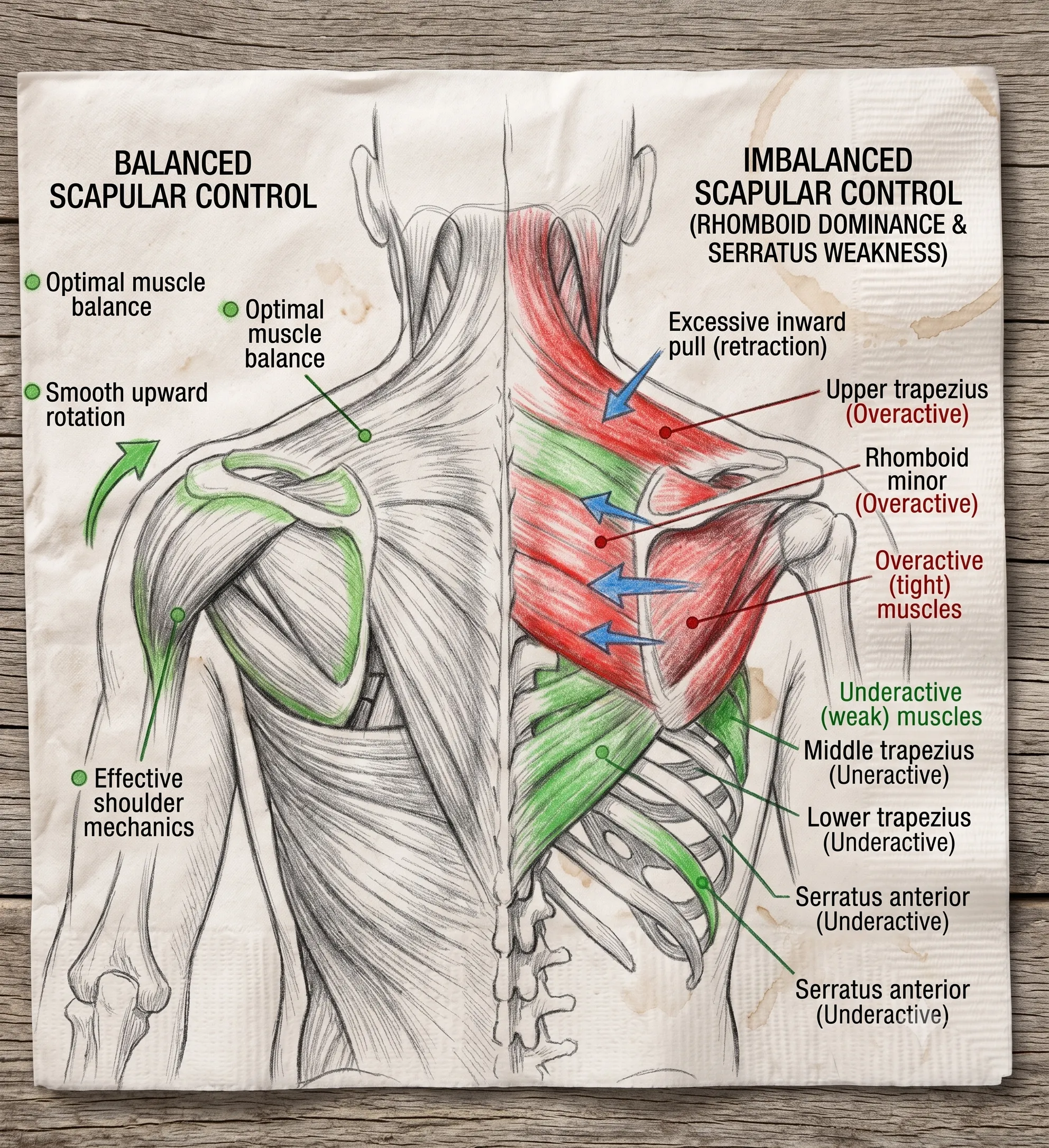
The disturbance Lewit describes is not a single faulty structure. It is a pattern across the movement system — joints that have lost their joint play, muscles holding tone they don't need, and a grip that recruits far more than it should. The painful tendon sits at the end of that pattern.
Muscle tone and trigger points.
Trigger points in the forearm muscles — extensor carpi radialis brevis and longus, extensor digitorum, brachioradialis — reproduce the elbow pain patients describe when pressed (Fernández-Carnero et al., Clin J Pain, 2007). Lewit treated these as a principal contributor, alongside supinator, triceps, and sometimes the shoulder muscles.
The shoulder blade.
People with tennis elbow have reduced strength and endurance in the muscles that stabilise the shoulder blade — the middle and lower trapezius and serratus anterior — compared with matched, pain-free people (Day et al., JOSPT, 2015). When the shoulder blade doesn't hold a stable base, the forearm works harder for the same task.
How you grip.
Much of what keeps a tennis elbow going is coordination rather than strength: gripping harder than the task requires, holding the wrist in a position that keeps the extensors loaded, stabilising with the forearm because the shoulder isn't doing it. This is what Dynamic Neuromuscular Stabilisation addresses — restoring the position and control of a joint so it works from a settled base rather than a braced one (Kobesová & Kolář, J Bodyw Mov Ther, 2014).
What about the tendon?
Degenerative change in the tendon can be present — wear and failed healing rather than active inflammation. It is worth knowing about, and it is seldom what treatment is usefully directed at.
Imaging findings of tendon damage do not reliably match how much pain or difficulty a person has (Chourasia et al., JOSPT, 2013). The same tendon changes appear on scans in people with no symptoms at all — around 10% of people aged 35 to 44, rising to about 60% by ages 55 to 65 (Paluch et al., Shoulder & Elbow, 2022).
A tendon finding, on its own, explains very little and offers treatment very little to work with. What responds is the dysfunction around it.
Why elbow-only treatment stalls
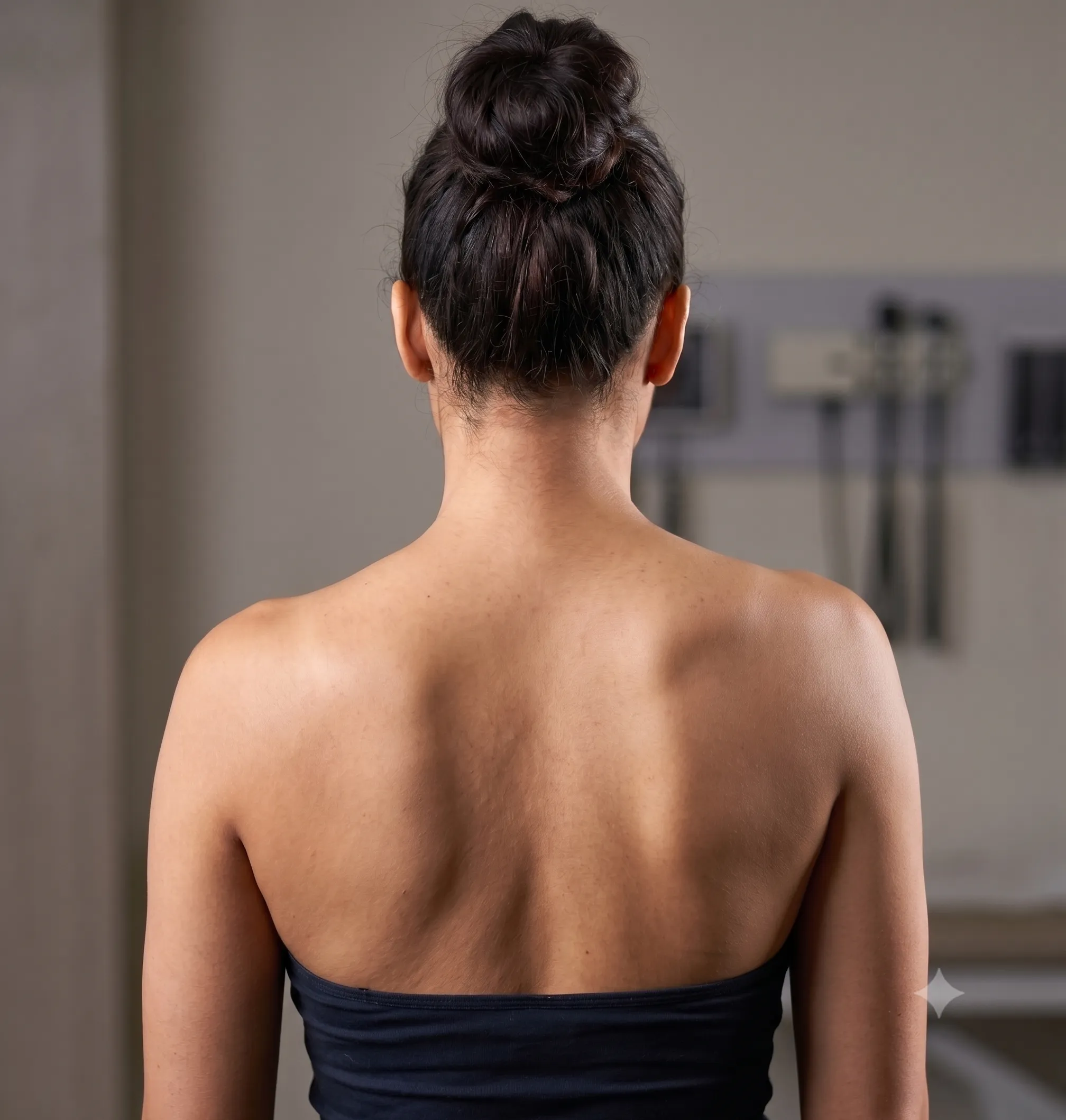
Can you see the imbalance that affects the elbow?
A 2024 multicentre randomised trial of 143 people compared standard multimodal physiotherapy with the same programme plus treatment directed at the neck and upper limb. At three months, 78% of the group receiving the wider treatment rated themselves much improved, against 36% of those treated locally (Dunning et al., Clinical Rehabilitation, 2024).
A corticosteroid injection follows a different pattern: best results at six weeks, worst results long-term, with a high rate of recurrence. In the same trial, physiotherapy outperformed a wait-and-see approach in the short term, and by twelve months most people in both groups had improved (Bisset et al., BMJ, 2006).
Treatment
- Look beyond the elbow. Evaluate trunk stability, shoulder girdle function, cervical spine, and wrist mechanics to identify the “key link” contributing the overload
- Restore Joint function – cervical and upper thoracic spine.
- Reduce muscle hypertonicity – muscle tightness
- Re-establish proper movement patterns with stability exercises
What to expect
Tennis elbow improves for most people over time — around 80% of cases resolve within a year (Sayegh & Strauch, Clin Orthop Relat Res, 2015). Treatment is about getting there sooner, staying able to work and train while you do, reducing the chance of it returning, and identifying the cases that aren't resolving and finding out why.
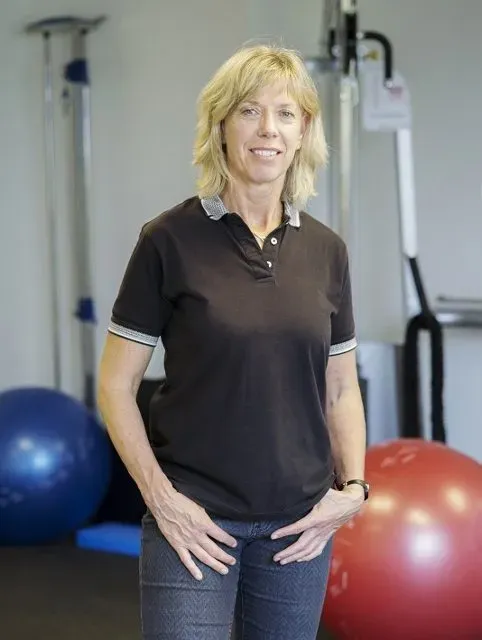
Assessment and treatment begin in the same session. Eva will explain what she found, which findings relate to your symptoms, and what the plan is.
Progress is usually gradual rather than sudden, and the exercises you do between appointments carry a good share of the work.
The Scandinavian Clinic
- Assessment that begins away from the elbow. Neck, upper back, shoulder-girdle, and forearm coordination are examined as standard.
- Swedish-trained orthopaedic manual therapy. Five years of university-level training in Sweden, with a strong emphasis on clinical reasoning and biomechanical assessment.
- Czech-trained in Dynamic Neuromuscular Stabilisation, in the Prague School tradition of Lewit, Janda and Kolář — where the approach on this page comes from. Learn more
- Covered by most extended health plans. As a Registered Massage Therapist, Eva's treatments are eligible for extended health benefits.
Frequently asked questions
Why would my neck matter if my elbow is what hurts?
The nerves supplying your forearm come from the neck, and the shoulder blade sets the base your arm works from. In one study of people with tennis elbow who reported no neck symptoms, over a third still had measurable cervical dysfunction on examination and 41% had a positive nerve-tension test (Coombes et al., 2014).
Can you get tennis elbow without playing tennis?
Yes — most people who get it never have. Lifting, climbing, painting, trades work, mouse use and repetitive kitchen tasks all bring it on. Those activities provoke the pain; the reason your arm can't tolerate them is what the assessment looks for.
Is tennis elbow an inflammation?
Not in the way most people assume. Where tendon change is present it is degenerative rather than actively inflamed — which is why rest and anti-inflammatories often don't resolve it.
I had a scan that showed tendon damage. Doesn't that settle it?
Imaging findings in tennis elbow don't reliably track with how much pain or difficulty people have (Chourasia et al., 2013), and the same changes appear in a large share of people with no symptoms — around 60% of people aged 55 to 65 (Paluch et al., 2022).
Why does it keep coming back after it feels better?
Because what was driving it was still there. Pain settles when the tissue is rested; if the joint restrictions, muscle tone and grip pattern that overloaded the arm haven't changed, returning to the same demands reproduces the problem.
Why didn't my brace or my injection work?
A brace changes where load falls; it doesn't change what's producing the load. A steroid injection gives good short-term relief and has been shown to produce worse long-term outcomes with a high recurrence rate (Bisset et al., BMJ, 2006).
Do I have to stop training or playing my sport?
Usually not entirely. Modifying the movement that aggravates it — grip, load, technique, equipment — while keeping the rest of your activity going is generally more workable than stopping.
Schedule your visit
If your tennis elbow keeps returning, or hasn't responded to rest, bracing or an injection, the next useful step is an assessment that looks past the elbow.
Most extended health plans in BC cover Registered Massage Therapy. For work-related (WorkSafeBC / WCB) cases, please call and speak with Eva directly to arrange — (604) 926-4883.
Book Your AppointmentSuite 202-101 West 16th Street, North Vancouver · (604) 926-4883