Shoulder Pain Treatment in North Vancouver
"Shoulder pain" is not a single condition.
At least a dozen distinct problems produce pain in roughly the same place, and which one you have determines what will help — a stiff, globally restricted shoulder needs the opposite handling from an overloaded rotator cuff. What they have in common is that the shoulder rarely fails on its own: it depends on the neck, the mid-back, the ribs, and the shoulder blade, and when those aren't doing their share, the shoulder takes the load.
Shoulder pain narrows your life quietly. Reaching a top shelf, putting on a jacket, fastening a seatbelt, sleeping on that side — all become things you plan around. Often there was no injury. The ache crept in and then wouldn't leave.

Common symptoms:
- Pain reaching overhead, out to the side, or behind your back
- Pain at night, especially lying on that side
- Weakness or a sense the arm won't do what you ask
- Catching, clicking, or a painful arc partway through the movement
- Stiffness that limits the movement itself, not just the comfort of it
- Aching that spreads into the upper arm
When does shoulder pain need urgent attention?
Most shoulder pain is not an emergency. However, some situations need prompt medical care rather than physical therapy:
🚨 Emergency Red Flags
Seek emergency medical care immediately if shoulder pain comes with chest pain, shortness of breath, sweating, or pain spreading to the jaw or left arm. Shoulder pain can occasionally signal a cardiac event.
Also seek prompt medical evaluation for sudden, significant weakness or inability to lift the arm after a fall, pain following major trauma, or a shoulder joint that appears visibly deformed.
Outside of these situations, shoulder pain that hasn't improved after a couple of weeks is a reasonable point to have it assessed.
Shoulder pain is not one condition
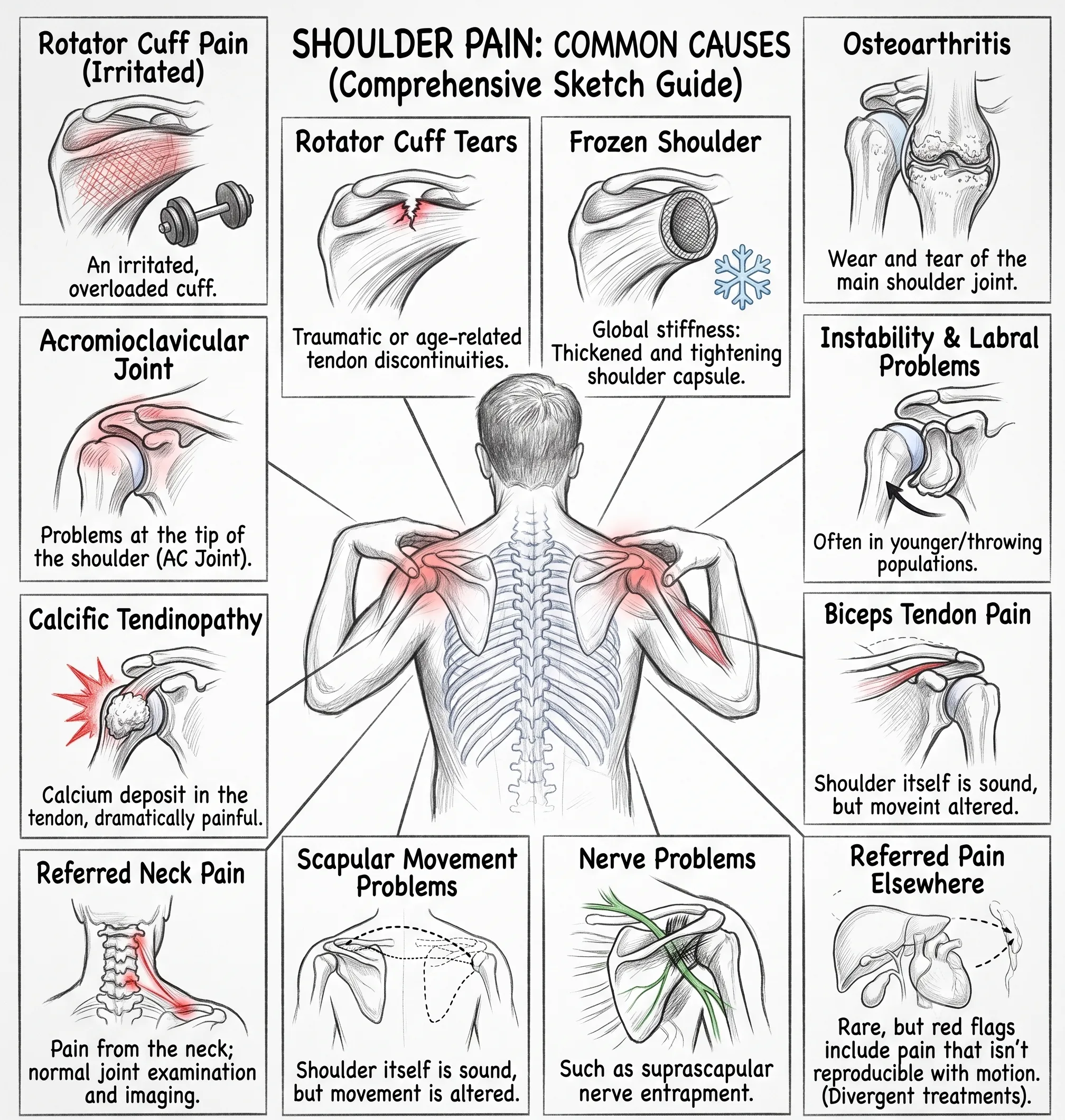
The diagnosis matters here more than it does almost anywhere else in the body, because the treatments diverge. The problems that commonly present as shoulder pain include:
- Rotator cuff–related pain (an irritated, overloaded cuff)
- Rotator cuff tears (traumatic or age-related)
- Frozen shoulder (global stiffness)
- Osteoarthritis of the main shoulder joint
- Acromioclavicular (AC) joint problems at the tip of the shoulder
- Long head of biceps tendon pain at the front
- Instability and labral tears
- Calcific tendinopathy (a calcium deposit in the tendon, which can be dramatically painful)
- Referred pain from the neck
- Scapular and thoracic movement problems (where the shoulder itself is structurally sound)
- Referred pain from internal organs
The physical tests don't cleanly separate them on their own. Commonly used shoulder tests have reasonable sensitivity but poor specificity — the Hawkins-Kennedy test correctly identifies about 74% of affected shoulders, but only rules out 57% of unaffected ones; Neer's sign sits at 78% and 58% (Hegedus et al., 2012). A positive test tells you less than most people assume.
This is also why research on shoulder pain is difficult to apply. A scoping review of studies on subacromial pain syndrome from 1972 to 2019 found no single recognized diagnostic criteria, concluding that studies are too varied to compare easily (Karel et al., 2023). When a trial reports that exercise helps shoulder pain, it is reporting an average across a mixed group of people whose underlying problems were not identical.
So the useful question isn't which treatment works for shoulder pain in general. It's what is actually happening in your shoulder, and what is putting it under load.
Why the rotator cuff gets overloaded
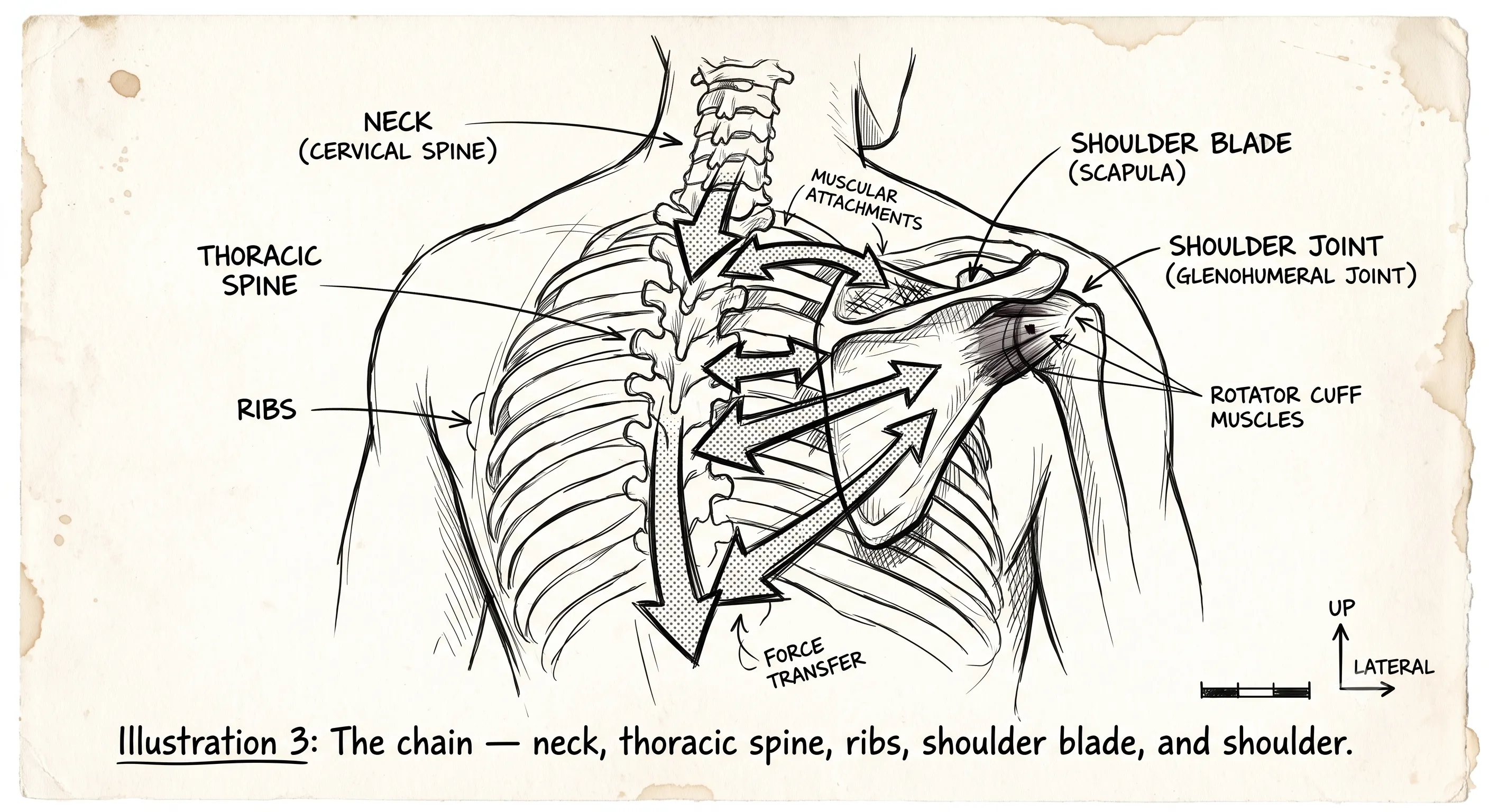
Karel Lewit and the Prague School look beyond the shoulder joint itself. When a rotator cuff is irritated, it is usually the victim carrying extra load because another part of the system isn't doing its share.
1. Disrupted joint centration and shoulder rhythm
For your shoulder to move smoothly without pain, two things must work in precise teamwork:
- Joint centration: The head of your arm bone must stay centered in its shallow socket throughout movement. If it drifts off-center, the bone rides upward and compresses the rotator cuff tendons above it.
- Arm-and-blade rhythm (Glenohumeral rhythm): As you raise your arm, your arm bone and shoulder blade move in a steady 2:1 ratio (2 degrees of arm movement for every 1 degree of shoulder blade rotation).
When this timing breaks down — causing the blade to shrug, tip forward, or wing outward — the arm bone pinches the tissues inside the joint. Research shows that as shoulder rhythm becomes increasingly disrupted, pain levels directly rise. Retraining this shoulder-blade coordination alongside general exercises improves pain and function far more than exercise alone (Zhong et al., 2024).
2. A stiff mid-back and ribs
Restoring mid-back and rib mobility frequently improves overhead reach.
An excessively rounded and stiff mid-back can place the scapula in a less favourable position, increasing the demands on the rotator cuff and contributing to overload. Treating the mid-back is therefore not simply about improving overhead range—it is about restoring a better relationship between the trunk, scapula and shoulder so the shoulder does not have to compensate.
3. Referred pain from the neck
Neck dysfunction commonly refers pain directly into the shoulder. A classic pattern is shoulder pain accompanied by restricted neck movement — where treating the neck relieves the shoulder. (Learn more on our neck pain page).
Trunk Posture and Shoulders
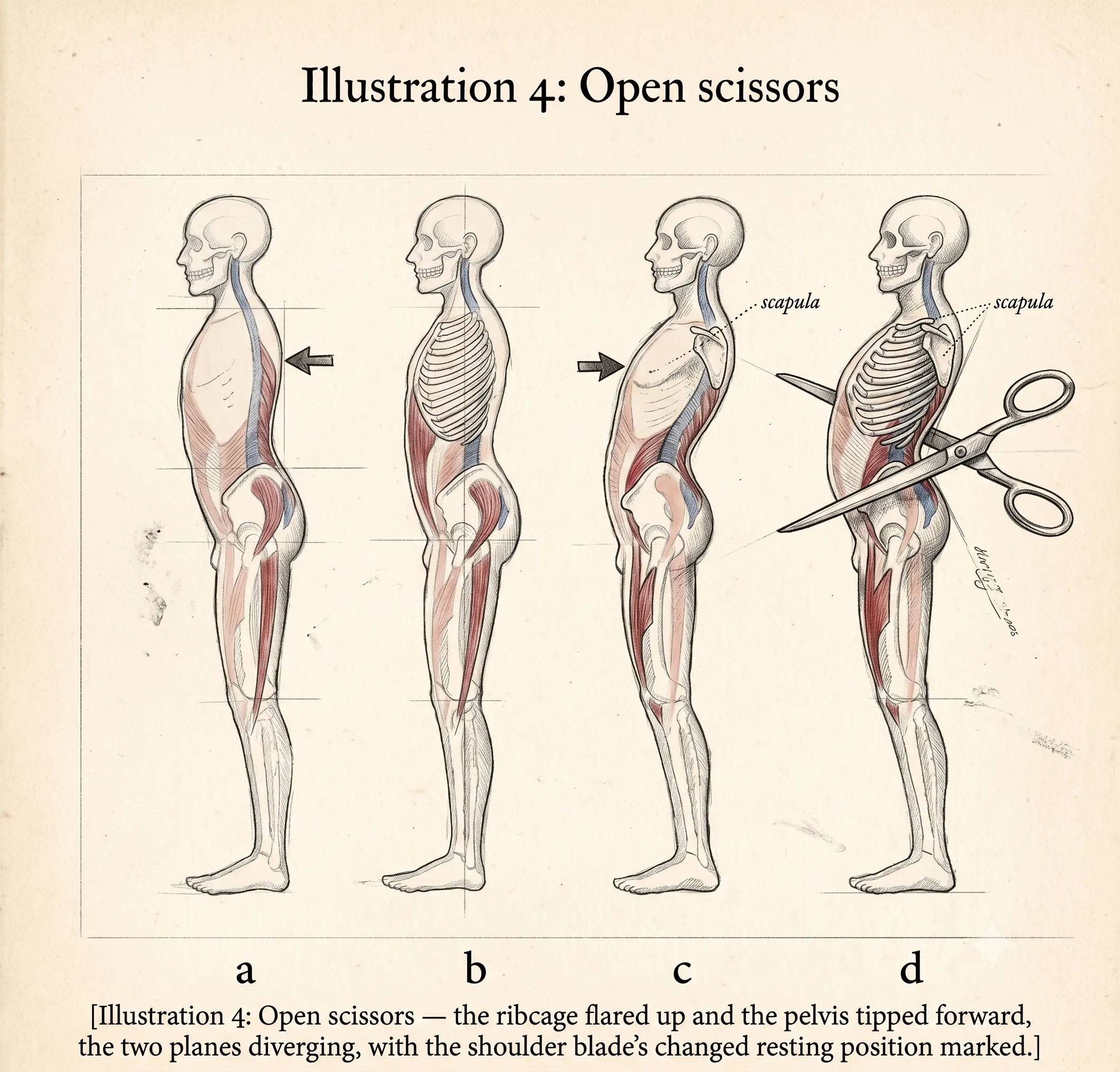
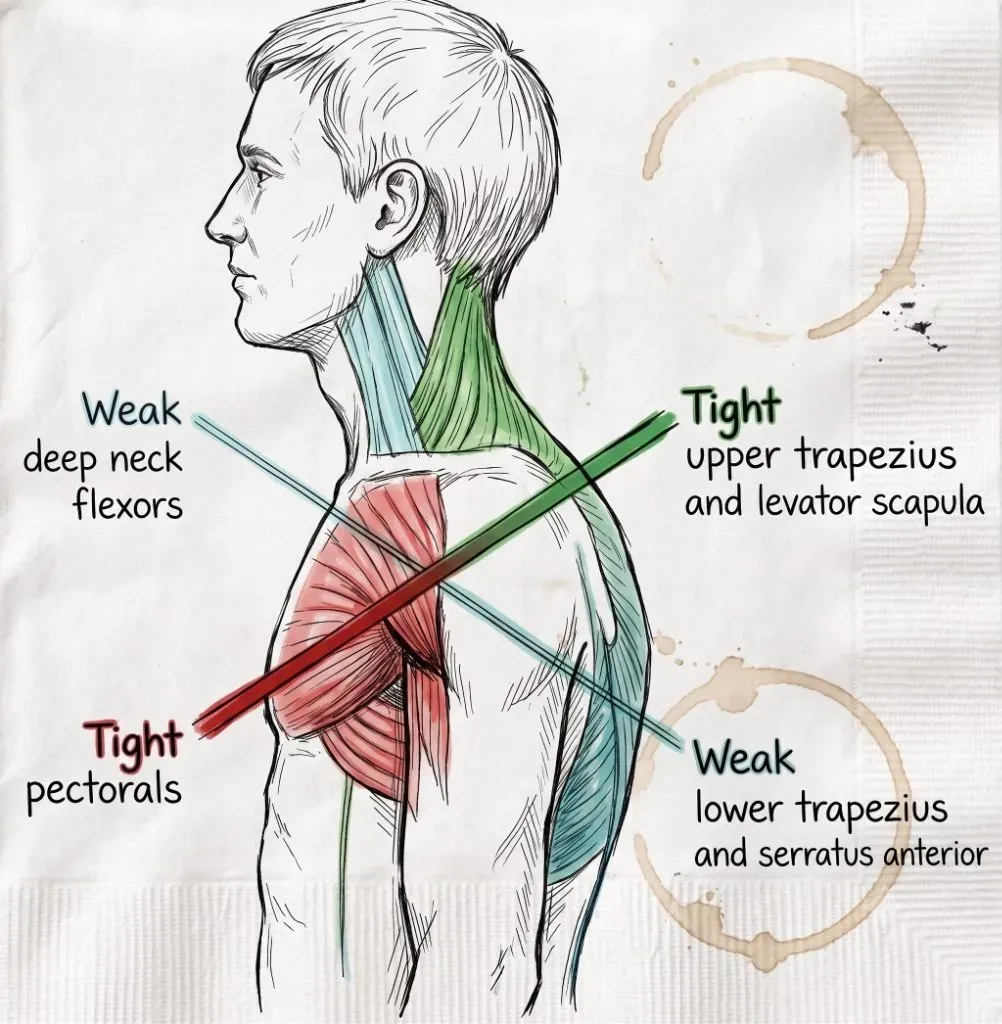
As an example, Hyperkyphosis (an extreme forward curve of the upper back) causes shoulder problems by pulling your shoulder blades forward and down, which limits your arm movement, pinches your tendons, and leads to painful conditions like shoulder impingement.
What about frozen shoulder?
Frozen shoulder describes a characteristic pattern of shoulder pain and stiffness, particularly loss of movement in several directions. External rotation is typically the most restricted, followed by elevation and internal rotation.
The term is often used interchangeably with adhesive capsulitis, although adhesive capsulitis refers more specifically to a condition involving inflammation and tightening of the joint capsule. Not every painful, stiff shoulder is adhesive capsulitis, so distinguishing it from other causes of restricted movement is an important part of the assessment.
Frozen shoulder is often described as progressing through three stages and eventually resolving on its own. Recovery can, however, take considerably longer than expected, and some people are left with persistent stiffness or reduced movement. The idea that it follows a predictable course to complete recovery without treatment is not well supported by the evidence (Wong et al., Physiotherapy, 2017).
For this reason, the aim is not simply to wait for the shoulder to"thaw", but to assess what is limiting movement and determine what treatment and rehabilitation may help.
What about a scan or a rotator cuff tear?
Rotator cuff changes — including tears that cause no pain at all — are a normal part of getting older. A finding on an MRI report does not automatically prove it is the true source of your pain, nor does it decide treatment on its own.
Where pain travels down the arm past the elbow, or comes with numbness, tingling, or weakness in the hand, that points toward a neck issue rather than a purely local shoulder problem — another key distinction evaluated during assessment.
Treatment
What treatment looks like depends on what the assessment finds — a stiff shoulder, an overloaded cuff, and a shoulder problem driven by the neck require three completely different plans. The sequence below outlines the general approach:
- Establish the underlying issue: Neck movement, thoracic spine and rib mobility, shoulder motion during arm elevation, joint centration, trunk posture, and whether limitation is driven by pain or structural stiffness.
- Soft tissue treatment for tight muscles: Massage, facia release, specific stretching, trigger point therapy, and targeted soft-tissue work.
- Restore mobility: Specific mobilization of the thoracic spine, ribs, and neck, as well as the shoulder joint itself where restricted.
- Retrain shoulder-blade coordination: Specific exercises to restore proper muscle patterns. Dynamic Neuromuscular Stabilization uses positions from infant motor development. These developmental positions promote shoulder blade and core coordination naturally without “overthinking” (Kobesová & Kolář, J Bodyw Mov Ther, 2014). [Learn more about DNS →]
- Progressive loading: Light rotator cuff activation, progressing toward the functional demands of your daily life, work, or sports. Structured exercise is the evidence-based first-line treatment for rotator cuff–related shoulder pain (Pieters et al., JOSPT, 2020).
If you perform repetitive tasks — whether in sports like tennis, swimming, and climbing, or in daily work like computer use, painting, reaching, and heavy lifting — the issue is often a combination of factors: stiffness in the mid-back, limited shoulder mobility, and muscle compensation. Your specific reaching, lifting, or stroke mechanics are evaluated alongside the shoulder itself.
What to expect
The timeline depends on which problem you have, and you will receive an honest estimate after your initial assessment:
- A shoulder driven by thoracic stiffness may improve quickly.
- An irritated rotator cuff typically requires several weeks of treatment.
- A genuinely stiff or frozen shoulder is often measured in months.
Assessment and treatment begin in the first session. Eva will explain what the examination revealed, what is affecting the shoulder, and what the plan involves — including if findings indicate care outside her scope of practice.
Home exercises often play an essential role. The focus is always on movement quality rather than high repetition counts.
The Scandinavian Clinic
- Targeted differential assessment: Identifying the cause of your shoulder pain. Neck, thoracic spine, ribs, shoulder girdle, and posture are examined as standard.
- Swedish-trained orthopaedic manual therapy. Five years of university-level training in Sweden, with a strong emphasis on clinical reasoning and biomechanical assessment.
- Czech-trained in Dynamic Neuromuscular Stabilization: Trained in the Prague School tradition of Lewit, Janda, and Kolář. [Learn more]
- Covered by most extended health plans: As a Registered Massage Therapist, Eva's treatments are eligible for extended health benefits.

Frequently asked questions
Why does my shoulder hurt when I never injured it?
Maybe because the shoulder relies heavily on the neck, mid-back, ribs, and shoulder blade to function properly. When those regions don't do their share, the shoulder carries more load than it was designed for. Gradual-onset shoulder pain usually follows this pattern rather than a single traumatic moment.
Why do I need an assessment?
At least a dozen distinct conditions cause shoulder pain, and they require different approaches.
Do I need surgery?
Usually not. Structured exercise-based rehabilitation is the recommended first-line approach for most rotator cuff–related shoulder pain, ahead of corticosteroid injections or surgery (Pieters et al., 2020).
Is my rotator cuff torn?
It might be, but that may matter less than you think. Rotator cuff changes and asymptomatic tears are very common as we age. A finding on a scan does not automatically prove it is the primary source of your symptoms.
Why would you treat my mid-back or neck for shoulder pain?
An excessively rounded and stiff mid-back can place the scapula in a less favourable position, increasing the demands on the rotator cuff and contributing to overload. Treating the mid-back is therefore not simply about improving overhead range—it is about restoring a better relationship between the trunk, scapula and shoulder so the shoulder does not have to compensate. The neck is part of this system too. Cervical dysfunction can affect shoulder movement and muscle activity, and can also refer pain directly into the shoulder.
Why aren't you starting me on rotator cuff strengthening exercises right away?
Because loading a joint that isn't tracking properly reinforces the dysfunction that caused the pain. Restoring joint centration and movement quality comes first; strengthening follows.
Can posture really affect my shoulder?
Yes. The alignment of your ribcage directly dictates where your shoulder blade rests, changing muscle tension.
Does massage help shoulder pain?
Yes. Relieving tension in overactive muscles is an effective part of treatment.
Schedule your visit
If your shoulder pain developed without an injury, hasn't responded to previous exercise programs, or is limiting your sleep and daily reaching, an assessment can identify what is actually going on.
Book Your AssessmentSuite 202-101 West 16th Street, North Vancouver · (604) 926-4883
References
- Karel YHJM, et al. Terminology and diagnostic criteria used in studies investigating patients with subacromial pain syndrome from 1972 to 2019: a scoping review. Physiotherapy. 2023.
- Hegedus EJ, Goode AP, Cook CE, et al. Diagnostic accuracy of clinical tests for subacromial impingement syndrome: a systematic review and meta-analysis. Br J Sports Med. 2012;46(14):964–978.
- Zhong Z, Zang W, Tang Z, et al. Effect of scapular stabilization exercises on subacromial pain (impingement) syndrome: a systematic review and meta-analysis of randomized controlled trials. Frontiers in Neurology. 2024;15:1357763.
- Pieters L, Lewis J, Kuppens K, et al. An update of systematic reviews examining the effectiveness of conservative physical therapy interventions for subacromial shoulder pain. JOSPT. 2020;50(3):131–141.
- Wong CK, Levine WN, Deo K, et al. Natural history of frozen shoulder: fact or fiction? A systematic review. Physiotherapy. 2017;103(1):40–47.
- Kobesová A, Kolář P. Developmental kinesiology: three levels of motor control in the assessment and treatment of the motor system. J Bodyw Mov Ther. 2014;18(1):23–33.
- Frank C, Kobesová A, Kolář P. Dynamic neuromuscular stabilization & sports rehabilitation. Int J Sports Phys Ther. 2013;8(1):62–73.
- Lewit K. Manipulative Therapy: Musculoskeletal Medicine. Churchill Livingstone; 2009.
- Page P, Frank C, Lardner R. Assessment and Treatment of Muscle Imbalance: The Janda Approach. Human Kinetics; 2010.
Written by Eva Andersson, RMT · Last updated July 2026