Core Stability and Breathing: It's Not About How Strong Your Core Is
What's the difference between core strength and core stability?
Strength is how much force a muscle can produce. Stability is how well your body organises that force while you move.
You can have strong abdominal and back muscles, exercise regularly and hold a plank for minutes — and still have difficulty stabilising your body when you move. That's because stability depends on more than strength. It involves timing, coordination, breathing and the way the trunk manages pressure.
You've probably been training your core. There's no shortage of exercises out there, and they're not bad exercises. But core stability isn't really about how strong those muscles are. It's about how your nervous system organises them when you move.
Book Your Assessment · See all conditions treated
🚨 When breathing symptoms need a doctor first
Some of this page is about breathing mechanics. That's a different question from whether breathing is hard. Seek urgent medical care for shortness of breath that comes on suddenly, breathlessness at rest, chest pain or pressure, coughing up blood, or breathing difficulty with dizziness, fainting, or a blue tinge to the lips or fingertips. See your family physician first for new or worsening breathlessness on exertion, a persistent cough or wheeze, or a known or suspected heart or lung condition.
Strength and Stability Are Not the Same Thing
You can have very strong core muscles and still have poor core stability. The muscles around the trunk — including the diaphragm, abdominal wall, pelvic floor and muscles around the spine — work together as part of the body's stabilising system.
When you reach, step, lift or turn, the nervous system has to coordinate the trunk with the movement of the limbs. Much of this happens automatically. When the system works well, you don't feel it happening. The important question is therefore not simply how strong the muscles are. It's whether the body can organise them effectively when movement begins.
Research has demonstrated differences in the timing of trunk muscle activity in people with and without low back pain. In one study, the deep abdominal wall activated ahead of shoulder movement in people without back pain, while activation was delayed in people with low back pain.
That's not simply a question of strength. It's a question of how the nervous system organises the sequence.
Where the Stability Actually Comes From
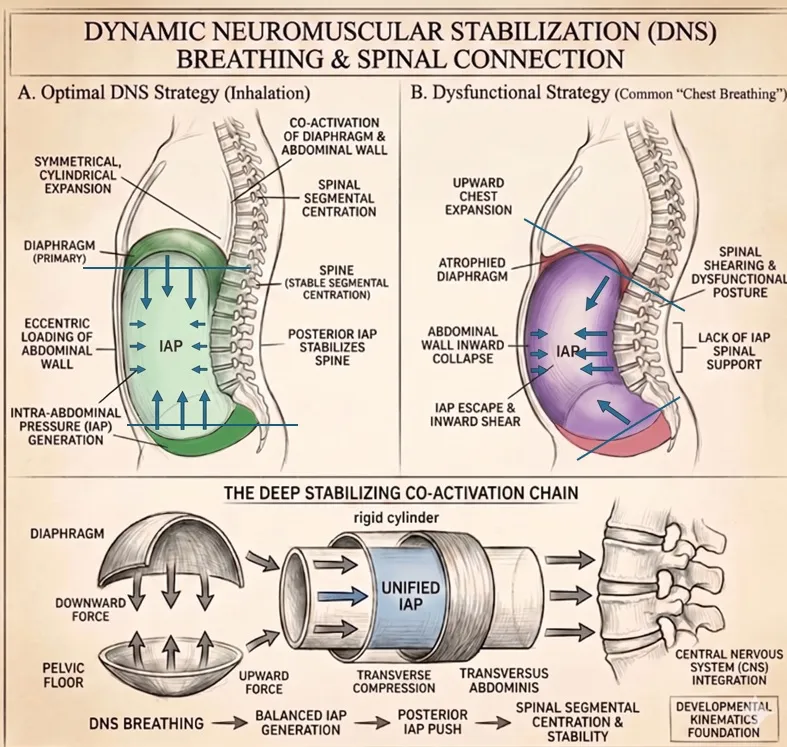
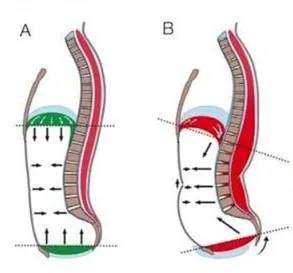
One of the important pieces of the stabilising system is the diaphragm. The diaphragm is primarily a breathing muscle, but it also contributes to trunk stability. When you inhale, the diaphragm descends and changes pressure inside the abdominal cavity.
That pressure works together with the abdominal wall, pelvic floor and muscles around the spine to help support the trunk. Think of the trunk as a cylinder:
- the diaphragm forms the top
- the pelvic floor forms the base
- the abdominal wall forms much of the front and sides
- the spinal muscles contribute from behind
The system has to work together. The diaphragm therefore has two closely related jobs: helping you breathe and contributing to the stability of the trunk.
Research using dynamic MRI has shown that diaphragm movement changes when the limbs are working against resistance, suggesting that the diaphragm contributes to postural demands as well as quiet breathing.
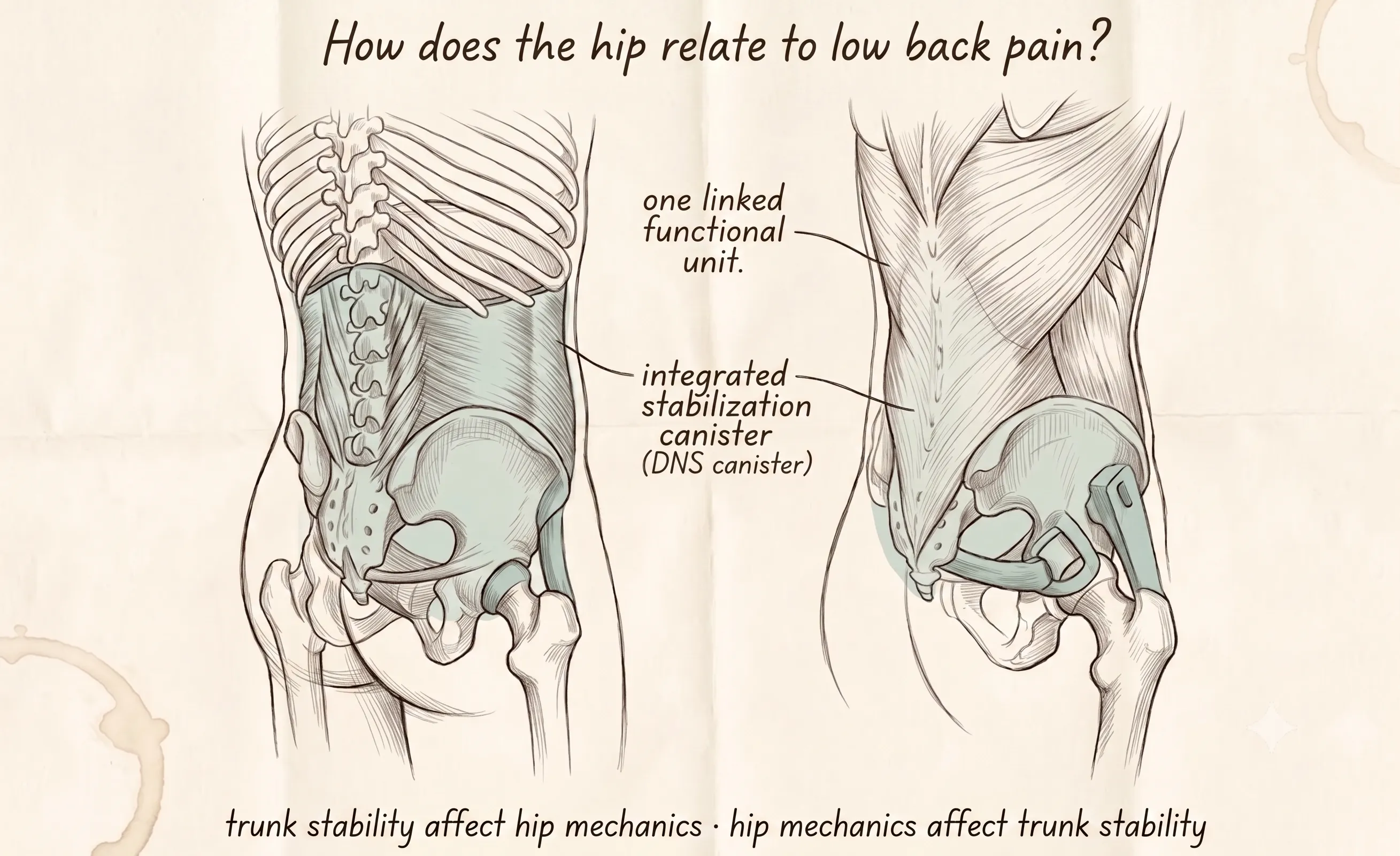
Trunk stability and the diaphragm affect other mechanical structures like i.e. the hip.
This relationship between breathing and stabilisation is an important part of the Dynamic Neuromuscular Stabilisation approach developed at the Prague School of Rehabilitation Medicine.
What"Correct" Breathing Looks Like
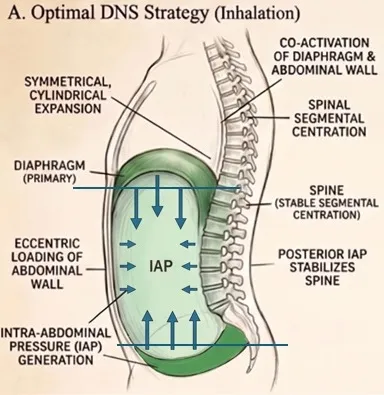
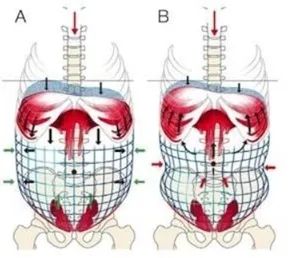
When the diaphragm works effectively, expansion can occur around the lower ribcage and abdomen — front, sides and back. This is sometimes described as 360-degree expansion. It is not simply about pushing your stomach forward.
A useful way to think about it is as a cylinder. When you breathe in, the cylinder expands. The aim is for pressure to be distributed through the trunk rather than simply pushing one part of the abdomen outward.
How Breathing and Stability Can Become Disconnected
Breathing can change for many reasons. For example:
- Pain. Breathing patterns can change when movement is painful or uncomfortable.
- Stress and anxiety. These can influence breathing toward a more upper-chest-dominant pattern.
- Posture. The position of the ribcage and pelvis can influence how the diaphragm and trunk work together.
- Habit. A breathing strategy can become familiar and automatic over time.
The important point is that breathing can remain comfortable while the way it contributes to movement and stabilisation is less efficient. This is one reason breathing mechanics can be worth assessing even when someone has no obvious breathing problem. For more on the relationship between posture and movement, see Posture.
Why Exercises Can Look Right but Miss the Point
Someone can perform a dead bug, plank or other core exercise with good-looking form. The spine stays relatively controlled. The arms and legs move smoothly. The exercise feels difficult. But the visible movement doesn't necessarily tell you which muscles are organising the movement underneath. A person can complete an exercise while using a compensatory strategy that has become familiar.
This isn't necessarily a problem with the exercise. It may simply mean that strength and motor control are different things. That distinction is important when the goal is not only to become stronger, but to improve how the body coordinates movement.
The Hollowing vs Bracing Question
If you've looked into core training, you've probably encountered conflicting advice. "Draw your navel toward your spine." "Brace as if you're about to be hit." Both approaches are used in different forms of exercise and rehabilitation.
DNS approaches the problem differently. Rather than beginning with a conscious instruction to switch individual muscles on, the aim is to improve the underlying coordination of breathing, pressure and movement. The objective isn't to hold your abdominal muscles tightly all day. The objective is to develop a stabilising response that becomes increasingly automatic.
Why This Matters
The relationship between diaphragm function, trunk stability and back pain has been studied in people with chronic or recurrent low back pain. Studies have found differences in diaphragm movement and fatigability between some people with low back pain and people without it.
These findings are interesting, but they do not establish that altered diaphragm function causes back pain. They show that breathing and postural function can be related, and that this relationship may be relevant when assessing someone with persistent movement or stability problems. This is also relevant to performance. When the trunk provides an effective base for movement, the arms and legs can transfer force through it more efficiently. The goal isn't to make the trunk rigid. It is to provide enough stability while allowing the rest of the body to move freely.
The Gap Between Understanding and Doing
Understanding how the system works and actually changing how you move are two different things. Some people can try a different breathing or stabilisation strategy and immediately recognise the difference. For others, a movement pattern that has been used for years feels completely normal. That makes it difficult to change without feedback. This is one reason hands-on guidance can be useful. The therapist may use the hands to guide the ribcage, abdomen or pelvis so that you can feel a different movement or pressure pattern. The purpose isn't for the therapist to"put" the correct pattern into you. The therapist helps you experience it. You then have to learn and reproduce it yourself.
Some Signs This Might Be Relevant to You
- You train your core regularly but still feel unstable.
- You can plank for a long time but still experience difficulty controlling your trunk during movement.
- You've been told you have a"weak core" despite being strong.
- Your stability decreases when you become tired or increase speed.
- You tend to breathe high into the chest and shoulders during demanding exercise.
- Your neck and shoulders become tense during core exercises.
- You find it difficult to breathe comfortably while maintaining a demanding position.
- You have difficulty maintaining trunk control when your arms or legs are moving.
These are not diagnostic signs. Many different things can produce these experiences. They are simply situations where looking at coordination rather than strength alone may be useful.
How a Session Works
The assessment looks at how your stabilising system coordinates movement. Depending on your situation, this may include:
- Breathing and stabilisation. Whether breathing can remain coordinated with trunk control.
- Ribcage and pelvis. How they relate to one another during movement.
- Movement coordination. Whether the trunk remains controlled while the limbs move.
- Muscle activity. Whether some muscles appear to be working excessively or compensating.
- Movement under load. Whether the pattern changes when resistance, speed or fatigue is added.
If joint restrictions or excessive muscle tension interfere with the movement, manual treatment may be used where appropriate. The training itself generally starts slowly and at low load. Once the basic pattern can be controlled, complexity and resistance can gradually be added. The aim is to establish coordination first, then build capacity.
The Scandinavian Clinic
- Stability is assessed as coordination, not simply strength. What's examined is how the body organises breathing, pressure and movement.
- Swedish-trained orthopaedic manual therapy. Five years of university-level training in Sweden, with a strong emphasis on clinical reasoning and biomechanical assessment.
- Czech-trained in Dynamic Neuromuscular Stabilisation, at the Prague School of Rehabilitation Medicine — where the approach described on this page comes from. Learn more about DNS →
- Covered by most extended health plans. As a Registered Massage Therapist, Eva's treatments are eligible for extended health benefits.
Frequently Asked Questions
Why don't my ab exercises help my back?
Because strength and movement coordination are different qualities. An exercise can make you stronger without necessarily changing how your nervous system organises the trunk when you move.
Should I stop doing planks and crunches?
Not necessarily. They can be useful for developing strength and endurance. The question is whether they address the particular limitation you are trying to change.
I don't have trouble breathing. Why would this apply to me?
You can breathe comfortably and still use a breathing pattern that contributes less effectively to trunk stabilisation during movement. The issue isn't necessarily whether you can breathe. It is how breathing and movement work together.
Isn't this just belly breathing?
No. The aim isn't simply to push the abdomen forward. It is to develop expansion around the lower ribcage and abdomen — including the sides and back — while coordinating that expansion with movement.
How is this different from breathing exercises for relaxation?
Breathing exercises for relaxation generally aim to influence arousal and calm the nervous system. The breathing work described here is primarily concerned with the mechanics of trunk stabilisation during movement and load. They can be useful for different reasons.
Should I hollow or brace?
Neither needs to be the starting point. Both are conscious strategies. The aim here is to improve the underlying coordination so that stabilisation becomes increasingly automatic.
How long does it take?
There is no fixed timetable. Learning a movement pattern depends on the individual, how long the existing strategy has been present, and how consistently the new pattern is practised.
Schedule Your Visit
Book an assessment and start treatment based on what the examination finds.Book Your AssessmentSuite 202-101 West 16th Street, North Vancouver · (604) 926-4883
References
- Hodges PW, Richardson CA. Inefficient muscular stabilization of the lumbar spine associated with low back pain: a motor control evaluation of transversus abdominis. Spine. 1996;21(22):2640–2650.
- Hodges PW, Butler JE, Gandevia SC, et al. Changes in intra-abdominal pressure during postural and respiratory activation of the human diaphragm. J Appl Physiol. 2000;89(3):967–976.
- Kolář P, Neuwirth J, Šanda J, et al. Stabilizing function of the diaphragm: dynamic MRI and synchronized spirometric assessment. J Appl Physiol. 2010;109(4):1064–1071.
- Kolář P, Šulc J, Kynčl M, et al. Postural function of the diaphragm in persons with and without chronic low back pain. JOSPT. 2012;42(4):352–362.
- Janssens L, Brumagne S, McConnell AK, et al. Greater diaphragm fatigability in individuals with recurrent low back pain. Respir Physiol Neurobiol. 2013;188(2):119–123.
Written by Eva Andersson, RMT · Last updated August 2026